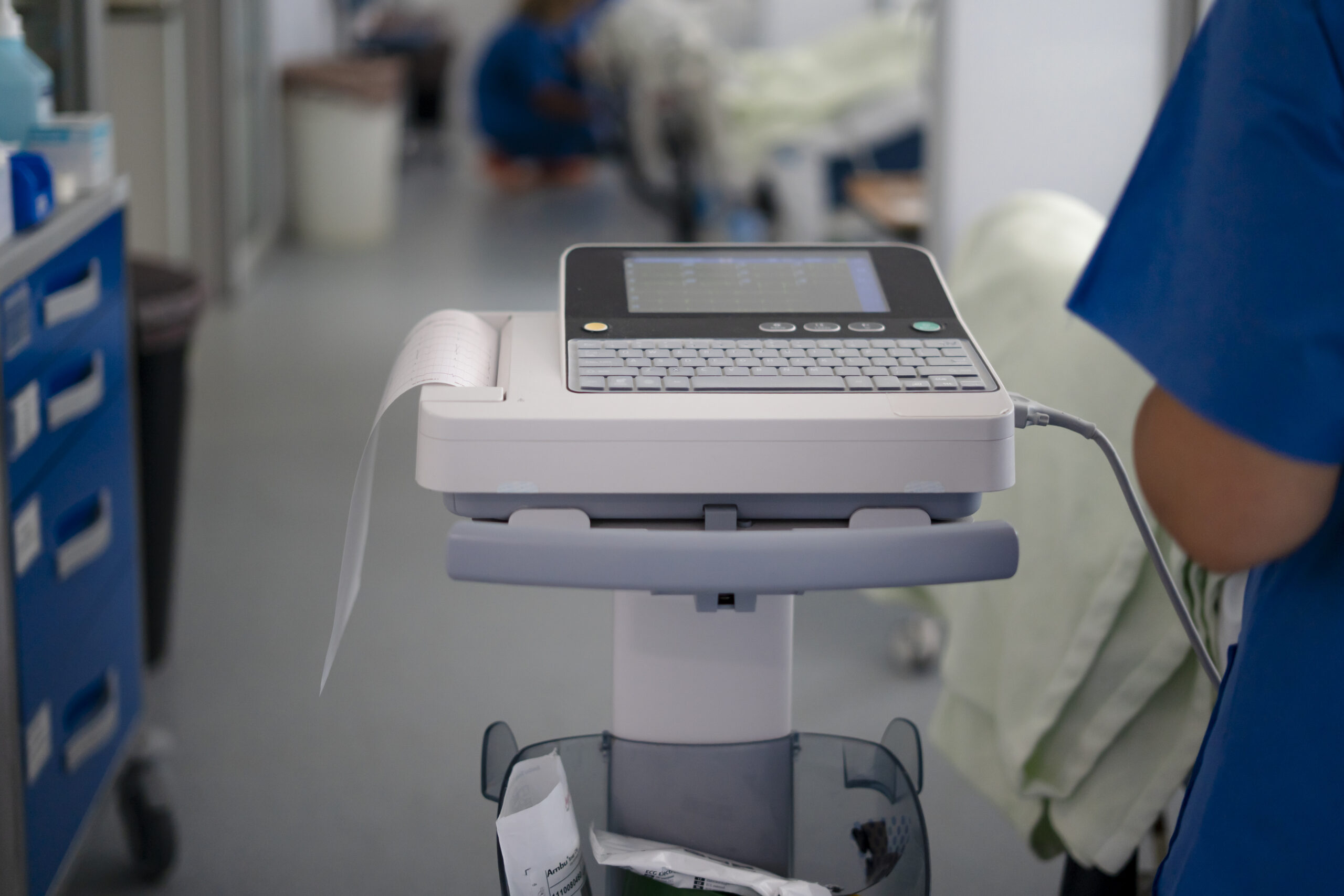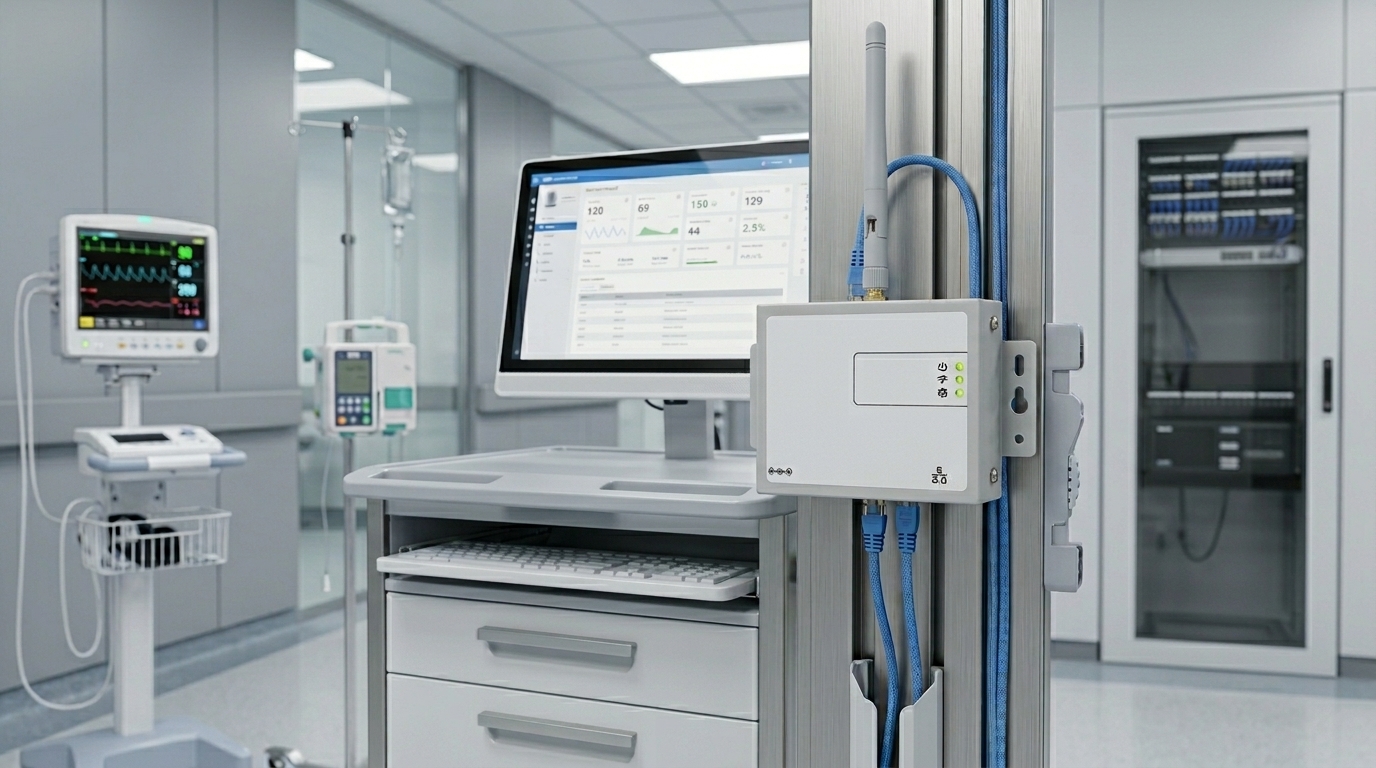
Medical carts move. Diagnostic equipment follows the patient. Ward rounds cover ground. NHS clinical environments are built around this mobility, with enterprise Wi-Fi infrastructure installed to support it.
The problem is that a large proportion of medical equipment in NHS trusts was not designed with wireless connectivity in mind. It has an RJ-45 Ethernet port. It expects a cable. When that cable is removed, the device loses network access, cutting it off from the EPR system and any connected clinical workflow.
Replacing this equipment to gain wireless capability is the obvious answer. It is also, in most NHS trusts, an impractical one. Capital budgets are constrained. Clinical revalidation takes time. And equipment that is still clinically effective does not justify replacement on connectivity grounds alone.
There is a more practical answer: a Wi-Fi bridge.

What is a Wi-Fi bridge and how does it work with medical equipment?
A Wi-Fi bridge sits between an Ethernet-only device and a wireless network. The medical device connects via its standard Ethernet port, and the bridge handles the wireless connection transparently. From the device’s perspective, nothing has changed. From the network’s perspective, it is a standard wireless client. No drivers, no configuration changes, no involvement from the device manufacturer.
The Silex BR-330AC-LP operates in two modes. In single-client mode, it bridges one Ethernet device to Wi-Fi. In multi-client mode, it bridges up to 16 Ethernet devices connected through a hub using a single bridge unit. For equipment trolleys carrying multiple devices, multi-client mode means one bridge serves the entire trolley.
This is a hardware solution to a well-defined infrastructure gap. The medical device does not need to be reconfigured. The bridge is an infrastructure component, not a clinical device, which keeps EBME involvement minimal.
Why is enterprise-grade security essential in NHS Wi-Fi environments?
NHS networks require IEEE 802.1X authentication and WPA2-Enterprise as a baseline for device connectivity. Consumer or prosumer Wi-Fi bridges do not support 802.1X, which means devices connected through them fail enterprise authentication and are typically placed on less-secure guest network segments. The Silex BR-330AC-LP supports WPA2-Enterprise with 802.1X authentication and TLS 1.2, making it compatible with standard NHS enterprise Wi-Fi infrastructure.
This distinction matters directly for DSPT compliance. The DSPT requires NHS organisations to ensure that all devices connected to NHS networks meet minimum security standards. A bridge that cannot authenticate on an 802.1X network is not a viable option in an NHS clinical environment.
The BR-330AC-LP also supports MAC address filtering, which allows IT teams to control precisely which Ethernet devices can connect through the bridge to the NHS network. Combined with 802.1X authentication, this ensures only authorised devices gain network access. For healthcare wireless security, this level of access control is the minimum standard NHS network teams expect from any device on clinical infrastructure.
Does fast roaming actually matter for ward-based medical equipment?
Yes. Standard Wi-Fi handover between access points takes 200-300ms. For mobile clinical equipment, this causes connection drops long enough to trigger application timeouts and interrupt data transmission. IEEE 802.11r fast roaming reduces this handover to under 50ms by pre-negotiating authentication with the target access point before the device moves. The Silex BR-330AC-LP supports 802.11r, maintaining stable connectivity as equipment moves across ward environments.
This is not an abstract performance metric. When an EPR session on a medical cart drops because a Wi-Fi handover took too long, a clinician loses data or has to re-authenticate manually. At scale, across a ward or a trust, this becomes a significant operational friction point.
NHS England Digital’s guidance on Wi-Fi roaming references 802.1X and RADIUS authentication as the basis for NHS roaming infrastructure. A bridge that supports 802.11r fast roaming works within this existing infrastructure rather than around it.
It is worth noting that 802.11r compatibility requires access point support on both sides. The BR-330AC-LP’s roaming performance depends on the access points in the infrastructure also supporting IEEE 802.11r. Most enterprise-grade NHS Wi-Fi deployments do.
How much power does the BR-330AC-LP draw, and why does it matter on medical trolleys?
The Silex BR-330AC-LP draws less than 2.5W (RMS) during typical operation, approximately 45% lower than comparable bridges. At this power level, the bridge can run from a USB power bank rather than a mains connection, which is critical for medical trolleys that need wireless connectivity without a tethered power cable.
Medical trolleys are one of the most common use cases for Wi-Fi bridging in NHS environments. A trolley carries equipment that needs to stay connected as it moves through the ward. Mains power is available at fixed points, not in motion.
A bridge drawing 4-5W or more cannot realistically run from a portable battery for a full shift. The BR-330AC-LP’s sub-2.5W draw makes extended battery operation viable. For trusts where medical carts need to operate wirelessly for hours at a time, this is a practical specification requirement, not a secondary consideration.
The device also accepts power via an optional Y-shaped USB power cable, giving more flexibility in how it is integrated into existing trolley setups without any mechanical modification.
What is the cost case for bridging versus replacing medical equipment?
Medical equipment replacement is expensive. The capital cost of a wireless-native patient monitor or diagnostic device runs to tens of thousands of pounds per unit. Across a ward, that becomes a capital programme requiring EBME validation, procurement approval, decommissioning of existing equipment, and clinical training.
NHS capital constraints mean that trusts consistently face pressure on equipment investment. Equipment that is still clinically effective does not meet the threshold for replacement on connectivity grounds alone.
A Wi-Fi bridge changes the calculation. Adding enterprise wireless connectivity to existing medical equipment requires no clinical revalidation of the device itself, no EBME sign-off for the bridge (it is infrastructure, not a clinical device), and no decommissioning process. The total cost is a fraction of the equivalent replacement programme. For procurement and estates teams working within tight budgets, this is a capital avoidance argument with a clear cost differential.
“No NHS trust is going to replace functioning clinical equipment because it lacks built-in Wi-Fi. The equipment works, the clinical case for replacement is not there, and the capital is not available. A bridge that adds enterprise wireless connectivity for a fraction of the replacement cost is not a compromise. It is the practical solution.”
Sat Bhatti, Managing Director, Rugged Limited
How is a fleet of Silex bridges managed centrally?
The Silex BR-330AC-LP is managed through AMC Manager, Silex’s centralised device management platform. Configuration, firmware updates, and monitoring are handled across all deployed units from a single interface.
For large deployments, the BR Kitting Utility (a plug-in for AMC Manager) allows bulk configuration of multiple units with a specific network profile. For trusts deploying tens or hundreds of bridges across multiple sites, this removes the need for device-by-device manual configuration on site.
Silex can also work directly with deployment teams to supply pre-configured units for specific network environments. For system integrators managing large NHS rollouts, this reduces on-site commissioning time significantly.
Wireless connectivity without the capital programme
Medical equipment does not need to be wireless-native to operate wirelessly in NHS clinical environments. A well-specified Wi-Fi bridge adds enterprise-grade connectivity, fast roaming, and 802.1X authentication to existing Ethernet-capable devices at a fraction of the cost of replacement and without disrupting clinical operations.
For NHS trusts and system integrators looking to extend wireless connectivity to existing medical equipment, the Silex BR-330AC-LP is available through Rugged Limited. The device carries a 5-year warranty and is CE and RoHS compliant. Get in touch for a datasheet, a trial unit, or a technical discussion about your specific environment.
For trusts also managing legacy serial connectivity challenges alongside wireless requirements, the Digi Connect EZ WS addresses serial-to-IP integration for EPR deployments and is available through the same supply route.
Can the Silex BR-330AC-LP connect to NHS enterprise Wi-Fi with 802.1X authentication?
Yes. The Silex BR-330AC-LP supports WPA2-Enterprise and IEEE 802.1X authentication with TLS 1.2. It is compatible with standard NHS enterprise Wi-Fi infrastructure and RADIUS-based authentication systems.
How many devices can one Silex BR-330AC-LP bridge to Wi-Fi?
In single-client mode, one Ethernet device. In multi-client mode, up to 16 Ethernet devices connected through a network hub can be bridged to Wi-Fi through a single BR-330AC-LP unit.
Does the Silex BR-330AC-LP support fast roaming between hospital access points?
Yes. The BR-330AC-LP supports IEEE 802.11r fast roaming, which reduces Wi-Fi handover time from 200-300ms to under 50ms. This maintains stable connectivity as equipment moves between access points in ward environments. Access points in the infrastructure must also support 802.11r for this feature to function.
Can the Silex BR-330AC-LP be powered from a battery or USB power bank?
Yes. The BR-330AC-LP draws less than 2.5W during typical operation and accepts power via an optional USB power cable, making it suitable for medical trolleys and mobile equipment that need wireless connectivity without a fixed mains power connection.
What is the warranty on the Silex BR-330AC-LP?
The Silex BR-330AC-LP carries a 5-year warranty and is CE and RoHS compliant.