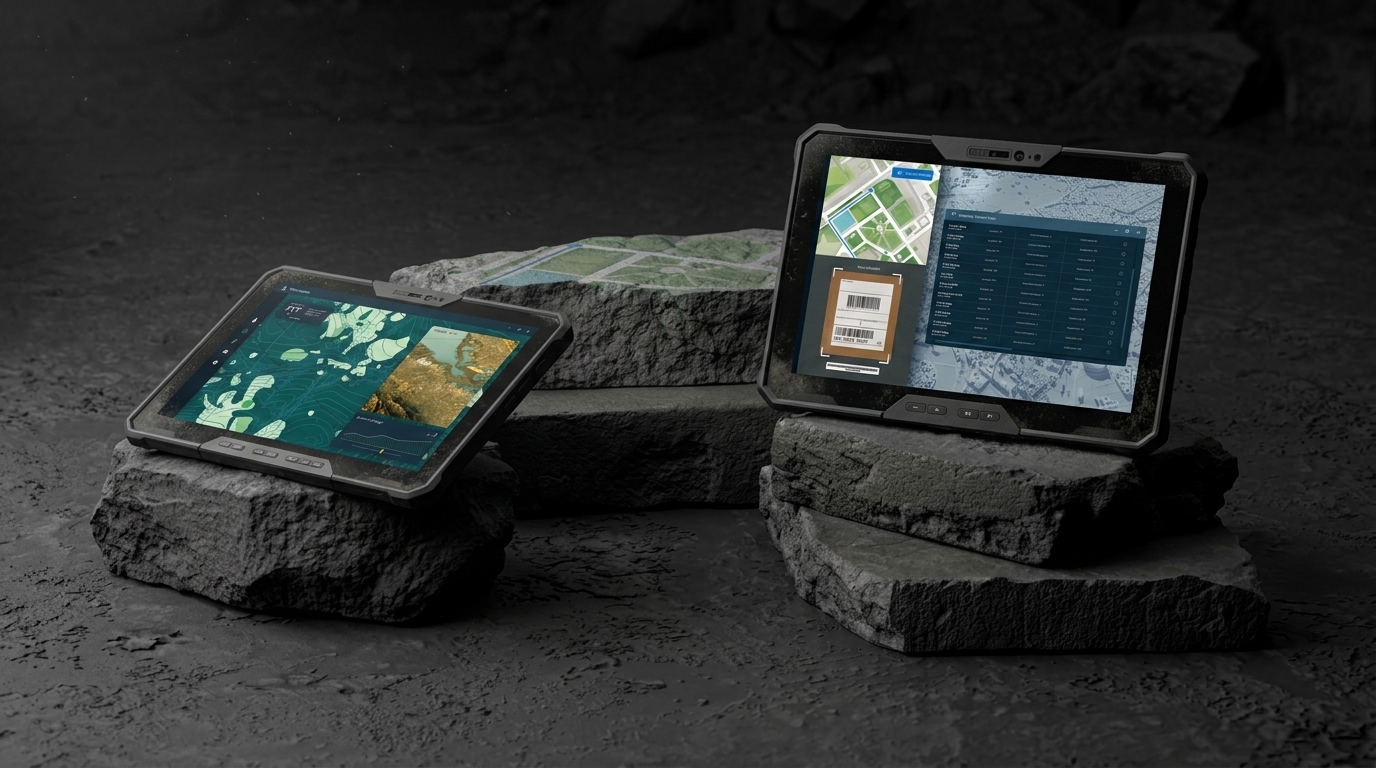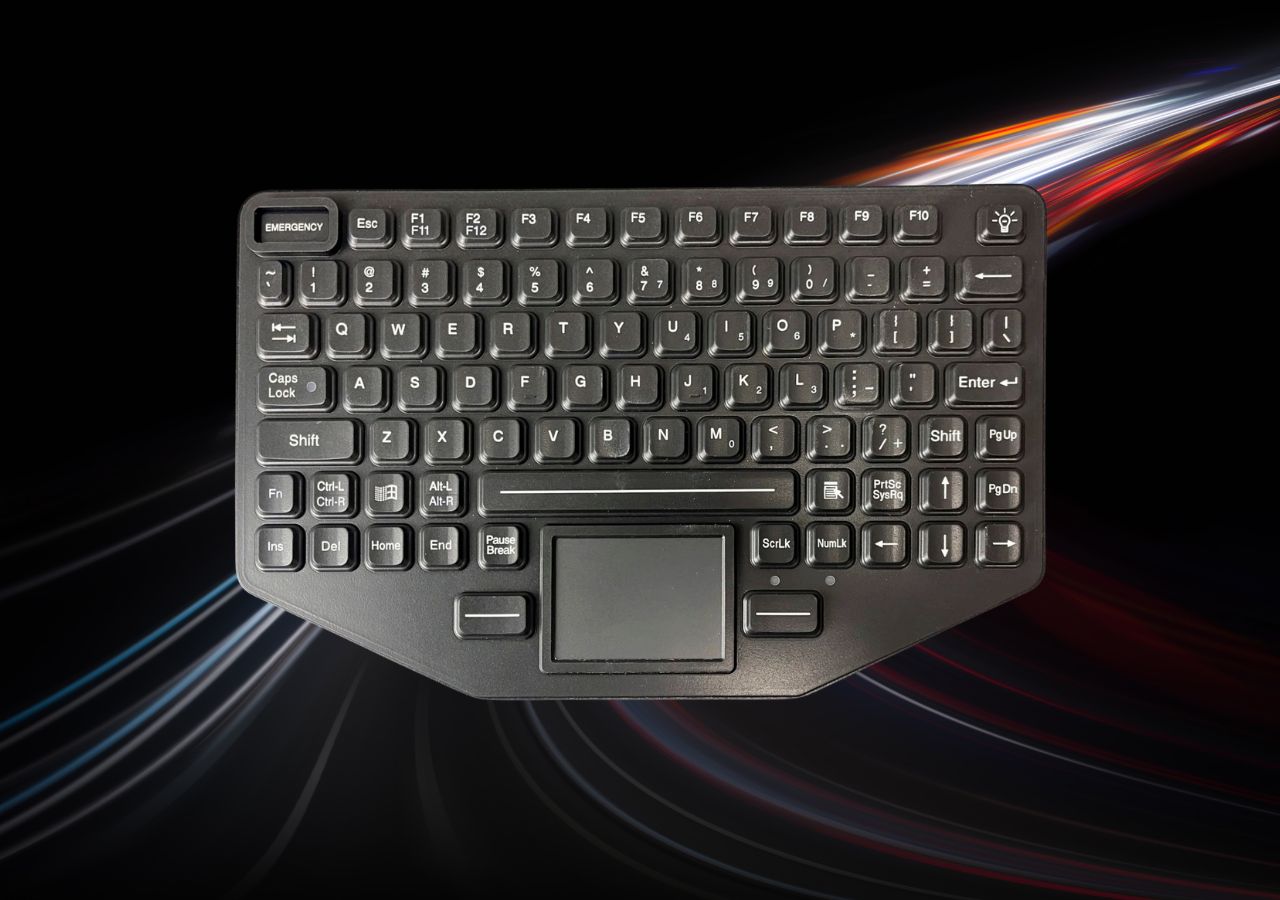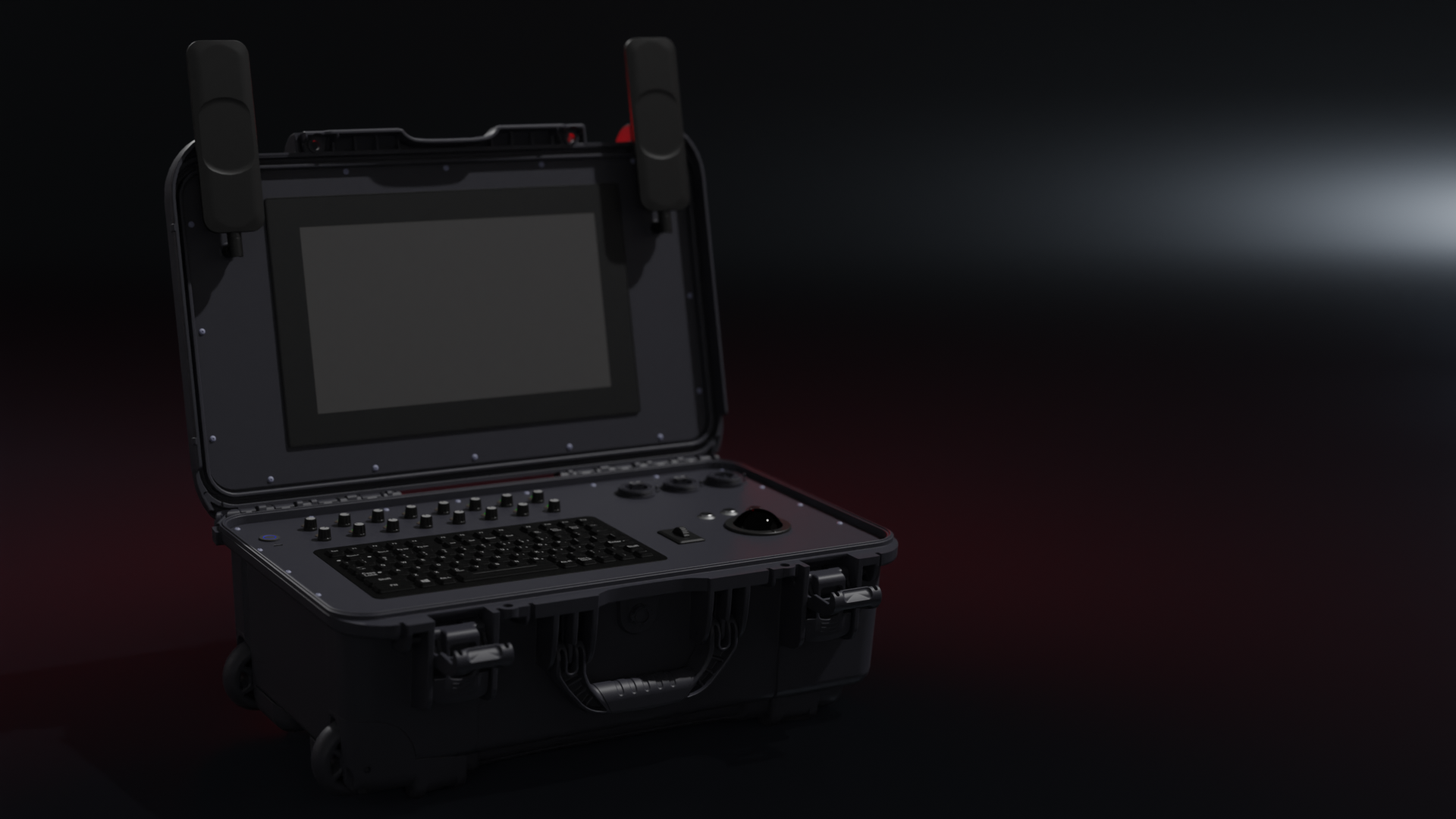
For drone Ground Control Stations, dedicated physical input devices eliminate the reliability failures of touchscreen-only interfaces under gloves, vibration and adverse field conditions. The iKey SLK-79-FSR and SL-80-TP provide compact sealed keyboards for GCS panel integration. The AK-39 suits arm-mounted and body-worn operator configurations. The SL-86-911-FSR covers full vehicle-mount installations. Cursor Controls OEM trackballs provide precision map and video navigation. Megatron Hall Effect joysticks deliver the tactile analogue control needed for UAV flight modes, gimbal operation and payload deployment. All are sealed to IP65 or above, rated to MIL-STD, and available in OEM form for integration into custom GCS chassis.
Executive Summary
The drone and UAS market has matured rapidly across defence, utilities, search and rescue, and infrastructure inspection. As programmes have evolved, so has the hardware around them. Ground Control Stations are no longer large vehicle-mounted consoles; today’s individual GCS is compact, man-portable, and frequently operated in exposed field conditions by a single operator. That places serious demands on the HMI. A keyboard, pointing device and optional joystick must fit within a small chassis, survive operational environments, and deliver reliable input when the operator is under pressure, wearing gloves, or working in rain. This article covers the iKey OEM keyboard range most commonly specified for GCS builds, the Cursor Controls trackball options for precision pointing, and the Megatron joystick range for analogue UAV control, all available through Rugged Limited.
At a Glance
- Touchscreen-only GCS HMI fails under gloves, in rain, in vibration and in high-stress operations
- iKey compact OEM keyboards (SLK-79-FSR, SL-80-TP, AK-39, SL-86-911-FSR) are purpose-built for GCS panel integration
- Sealed to IP66 or IP68, MIL-STD shock and vibration certified for field deployment
- Cursor Controls trackballs provide fixed-footprint precision pointing for map navigation and video feed control
- Megatron Hall Effect joysticks complete the HMI stack for operations requiring analogue UAV input
Ideal For
- Defence and military UAS programmes
- GCS hardware system integrators and OEMs building bespoke chassis
- Commercial drone operators in utilities inspection, infrastructure survey and SAR
- Aerospace and defence contractors specifying operator HMI for portable and vehicle GCS builds
- Vehicle-mounted GCS installations requiring VESA-mount or console-integrated keyboards
Not Ideal For
- Consumer or recreational drone operators with no field environmental requirements
- Office-based UAV management from a fixed desk setup
- Deployments where a standard consumer keyboard and mouse are operationally adequate
The Rise of the Individual Ground Control Station
Military and commercial drone operations have changed substantially in the past decade. Where once a Ground Control Station meant a large vehicle, multiple operators and considerable supporting infrastructure, the current direction of travel is firmly towards compact, man-portable individual GCS units that a single operator can deploy rapidly in the field. UK and NATO UAS doctrine has accelerated this shift, with disaggregated small-unit drone operations now a standard operational requirement across both ground and air forces.
Commercial operators have followed a parallel path. Utilities companies inspecting power line corridors, oil and gas operators surveying pipeline routes, and search and rescue teams deploying drones from mobile command vehicles all need a GCS that can operate in the same conditions as the aircraft it controls. That means rain, dust, cold temperatures, vehicle vibration and the physical demands of working away from a fixed desk in an unpredictable environment.
Modern drone software stacks cover mission planning, real-time video feeds, telemetry management and payload control. The GCS is the sole interface between the operator and the aircraft. Every arming command, mission waypoint, emergency stop and camera mode switch passes through it. The consequences of a failed input at the wrong moment range from a lost asset to a safety incident.
Touchscreen-only GCS builds are a common shortcut at the prototype and development stage. In the field they introduce three recurring failure modes: gloves block capacitive touch input; rain and contamination obscure or falsely activate the display; and under operational stress, a touchscreen provides no tactile confirmation that the input has registered. A physical keyboard alongside the display removes all three failure modes without adding significant bulk. The reliability gain is not marginal; it is categorical.
The Human-Machine Interface Challenge in GCS Design
A GCS HMI typically consists of a display, a keyboard, a pointing device and sometimes a joystick for analogue control. In a large fixed GCS, specifying these is straightforward. In an individual portable GCS chassis with strict size and weight constraints, every component requires careful selection.
The practical constraints are considerable. The keyboard must fit within the chassis footprint, often 300mm or less in width for a genuinely portable unit. It must be sealed against the elements to the same standard as the rest of the GCS. It must operate under glove use, which rules out capacitive touch keys. It must survive the shock and vibration of the vehicles and environments it deploys from. And it must work reliably with the drone control software running on the GCS computer, meaning standard USB HID compatibility is a baseline requirement.
OEM keyboard formats are the dominant approach for defence and aerospace GCS builds. These sealed units are designed for panel integration into a custom chassis without their own external housing. iKey’s OEM and panel-mount range is most frequently specified for this application, offering sealed keyboards in form factors that integrate directly into bespoke GCS enclosures.
iKey OEM Keyboards for Ground Control Station Builds
iKey manufactures a wide range of sealed rugged keyboards across multiple form factors. Four models are particularly relevant to GCS applications, covering the range from ultra-compact arm-mounted configurations through to full vehicle-mount keyboard consoles.
iKey SLK-79-FSR: Compact Backlit with FSR Pointing
The iKey SLK-79-FSR is a 79-key sealed keyboard in a 235.5 x 98.3mm footprint, one of the most compact full-QWERTY options in the iKey range. Sealed to IP66 and NEMA 4X, MIL-STD shock and vibration rated, and operating from -20°C to +60°C, it includes red backlit keys for low-light operations and an integrated Force Sensing Resistor pointing device that removes the need for a separate mouse in space-constrained GCS builds.

At 25.4mm deep and 0.45kg, the SLK-79-FSR is thin enough for panel integration into most portable GCS chassis designs. The USB interface is compatible with all Windows-based drone software stacks without additional drivers, and the 10-million-cycle key rating confirms a design intent of continuous-duty field operation rather than occasional desk use.
The FSR pointer is a practical advantage specific to GCS use. Unlike a touchpad, which can activate accidentally with a wet glove, an FSR pointer requires deliberate directional pressure to operate. Combined with IP66 sealing, this makes the SLK-79-FSR considerably more reliable than any touchpad-equipped alternative in exposed weather conditions.
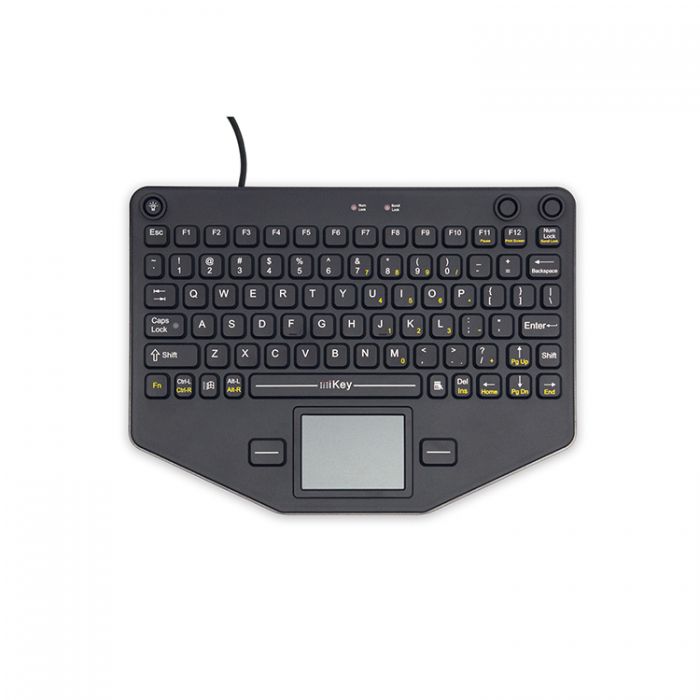
iKey SL-80-TP: Full Footprint with Integrated Touchpad
The iKey SL-80-TP provides an 80-key sealed keyboard with an integrated touchpad, sealed to IP66 and NEMA 4X, operating from -20°C to +60°C with red backlighting. It suits GCS console designs where a combined keyboard and pointing device is preferred and chassis space allows the larger form factor. The integrated touchpad eliminates the need for a separate pointing device, simplifying cabling and panel design for fixed-position GCS consoles. At 0.45kg, it is no heavier than the SLK-79-FSR despite its larger footprint.
iKey AK-39: Ultra-Compact with MIL-STD-461G EMC Certification
The iKey AK-39 is the most compact sealed keyboard in this selection. At 168.9 x 77.7 x 20.6mm and weighing just 0.23kg, it is configured for arm-mounted or body-worn operation where a conventional panel keyboard is impractical. Despite its small footprint, it includes an integrated Force Sensing Resistor pointing device and 39 keys in an alphanumeric layout, with a Snap-On faceplate for field maintenance.
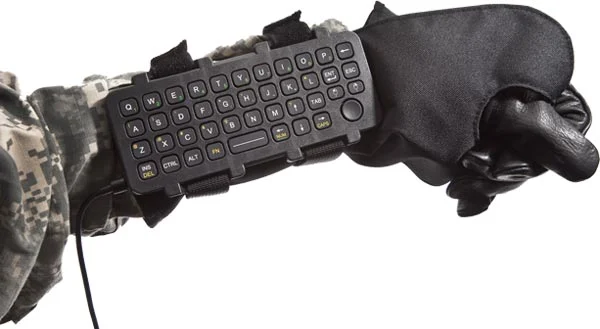
Two specifications make the AK-39 particularly significant for military UAS applications. First, it is sealed to IP68, rated for continuous submersion, rather than the IP66 jet-spray resistance of the other models. Second, the AK-39 carries MIL-STD-461G EMC certification, confirming that its conducted and radiated electromagnetic emissions are controlled to the level required for equipment operating alongside military communications and sensor systems.
In a drone GCS environment, EMC matters considerably. The operator is typically surrounded by radio links at 2.4GHz, 5.8GHz and 900MHz. A keyboard generating uncontrolled RF emissions in that environment risks introducing interference into the communication links the GCS depends on. The AK-39’s MIL-STD-461G certification addresses this directly, and it is the specification consistently requested by military programme integrators in the enquiries we receive.
The operating temperature range of -40°C to +70°C exceeds the standard -20°C to +60°C of the other models, making the AK-39 the correct specification for cold-weather UAS operations or equipment-bay installations with wide ambient temperature variation.
iKey SL-86-911-FSR: Vehicle-Mount with Full Key Layout
The iKey SL-86-911-FSR is the largest of the four keyboards covered here, at 289.6 x 160.0mm and 0.91kg. It provides an 86-key layout including a numeric section, sealed to IP66 and NEMA 4X, with MIL-STD shock and vibration certification, green backlighting and an integrated FSR pointing device. VESA mount and desktop installation options suit both vehicle console and fixed station installations.
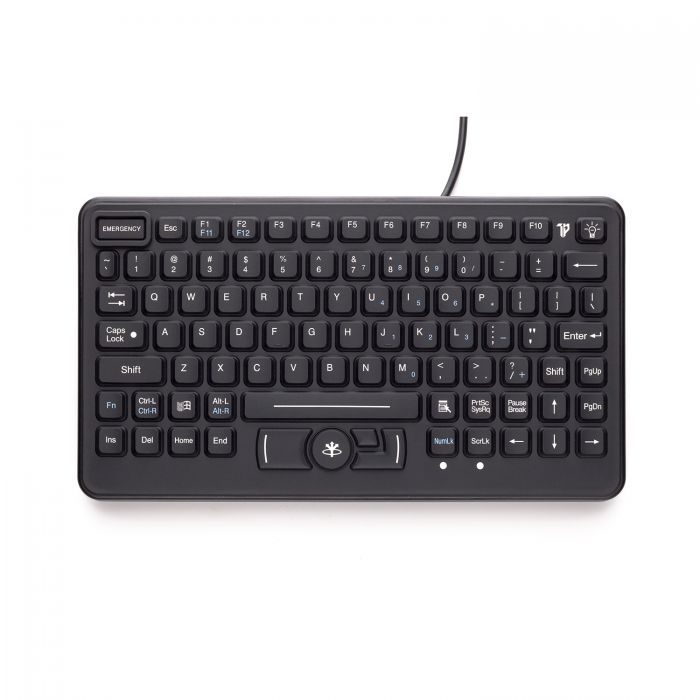
For vehicle-mounted GCS builds, whether from Land Rovers, armoured vehicles, specialist command vehicles or fixed infrastructure, the SL-86-911-FSR is the appropriate specification. The full key layout supports intensive operator workflows: entering GPS coordinates, accessing numeric menu items in mission planning software, and managing function key assignments for drone commands. The VESA mount allows secure integration into vehicle console designs with no risk of the keyboard shifting during transit.
The SL-86-911 range also includes a MIL-STD-461 EMC-certified variant (the SL-86-911-461) for programmes requiring EMC compliance in a full-size vehicle keyboard. Where the AK-39 covers portable and individual GCS with EMC requirements, the SL-86-911-461 covers vehicle-mounted GCS builds with the same requirement in a full 86-key layout.
Trackballs for Ground Control Station Precision Pointing
A mouse is impractical in any GCS that is not operating from a fixed flat desk. Portable GCS units rarely provide that surface; vehicle-mounted units are subject to vibration and motion; field operators may be kneeling, standing or working from a vehicle seat. A trackball resolves all of these constraints by providing precision cursor control from a fixed-footprint device that requires no surface to move across.
In drone operations, trackball precision matters most in three scenarios. Map interface navigation in mission planning software requires accurate cursor placement to set waypoints, define geofences and select target coordinates. Video feed review requires controlled, deliberate cursor movement for frame-by-frame review or timeline scrubbing. Target marking in ISR and surveillance operations requires steady cursor placement on live video: a task that demands the kind of controlled precision a trackball provides and a touchpad in a moving vehicle does not.
Cursor Controls manufactures the widest range of panel-mount and desktop rugged trackballs available in the UK market. The OEM panel-mount range, including the F38, X38, X50 and C50 series, integrates directly into GCS chassis panels without additional enclosures, providing sealed pointing devices matched to the IP and ruggedness requirements of the GCS itself. For standalone or rack-mount applications, the Cursor Controls X50 provides an IP68-sealed, laser-tracking OEM trackball in a rear-panel-mount format suited to GCS chassis integration. The ABS polycarbonate housing tolerates vibration, temperature extremes and repeated environmental cleaning, and the removable top ring allows maintenance without compromising sealed integrity.
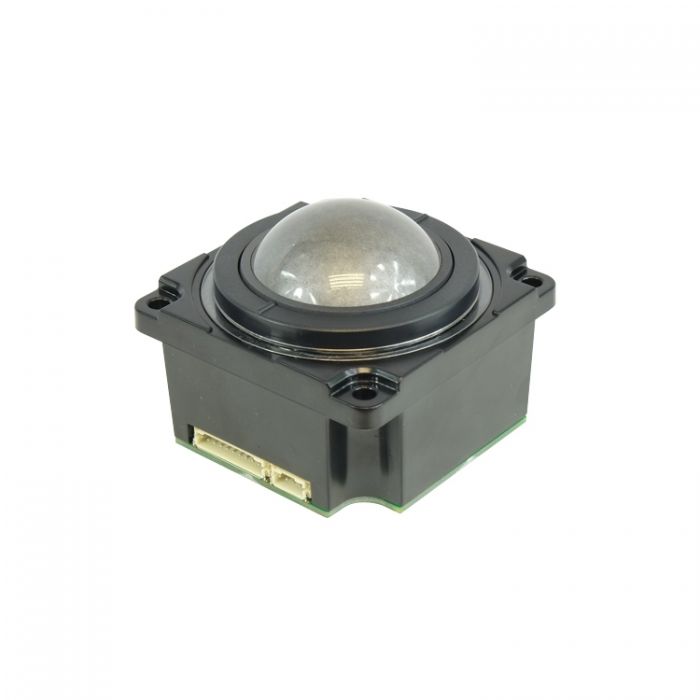
iKey also supplies keyboard-plus-trackball combination units within its OEM range for builds where a combined panel component is preferred over separate devices.
Rugged Joysticks for UAV Flight and Payload Control
Not all GCS operator inputs are discrete key presses. Flight mode control, camera gimbal positioning, payload deployment and manual override functions benefit from analogue proportional input: the kind of smooth, graduated control that a physical joystick provides and that a keyboard or touchscreen cannot replicate. Proportional analogue input allows the operator to hold a steady gimbal angle, make fine corrections to a manual flight path, or control payload positioning with a precision that discrete inputs do not offer.
Megatron manufactures a range of rugged OEM joystick designs specifically for integration into control systems and HMI panels, covering finger joysticks for compact panel-mount applications through to full hand joysticks for console integration. All use Hall Effect sensor technology, which provides contactless position measurement with no physical wear between the sensing element and the moving part. In a high-cycle application such as daily training operations or extended deployment, this translates directly into a longer service life with consistent accuracy across the full working range.
Megatron TRY50: The Field-Deployable Hand Joystick
The Megatron TRY50 is the sealed hand joystick for the most demanding field deployments. It provides up to three-axis control with infinite resolution, sealed to IP68 standard, with an operating temperature range of -40°C to +85°C covering both arctic operations and the elevated ambient temperatures found in vehicle equipment bays in hot climates. Rated for 10 million operational cycles, it supports analogue, USB and CAN (J1939) interface options. The choice of spring return or friction clutch return mechanism allows programme integrators to specify joystick behaviour matched to the UAV control characteristic the application requires.

Megatron 870: Vehicle-Mount Hand Joystick
The Megatron 870 is a 2-to-3-axis Hall Effect hand joystick rated from -20°C to +60°C with spring return to centre. At 5 million cycles, it suits commercial GCS applications where a reliable long-service Hall Effect joystick is required without the extreme environmental specification of the TRY50. The analogue interface is compatible with standard GCS computing platforms and custom control system integration.

Finger Joysticks for Compact Panel Integration
Where a full hand joystick is not practical in a compact GCS chassis, Megatron’s finger joystick range, including the TRY13, TRY22, 812 and 821 series, provides panel-mount analogue input in a minimal footprint. These suit GCS builds where a secondary analogue axis is needed alongside the primary keyboard, such as gimbal control while the operator maintains keyboard input for mission management tasks.
Technical Analysis: Specifications That Matter for GCS Peripheral Selection
IP Sealing
IP66 means the device is protected against powerful water jets from any direction, covering rain, spray from a moving vehicle and hose-down cleaning. IP68 certifies continuous submersion to a specified depth. For most GCS deployments, IP66 is adequate. For dismounted SUAS operators in exposed terrain in wet conditions, IP68 provides a meaningful additional margin. The AK-39 is the IP68-rated option in this selection.
MIL-STD-810: Shock and Vibration
MIL-STD-810H certifies performance following drop, shock and vibration testing across defined profiles. Method 514.8 covers vehicle vibration profiles for wheeled vehicles, tracked vehicles and rotary-wing aircraft environments. A keyboard certified under this standard has been tested against representative operational vibration spectra. For a vehicle-mounted GCS keyboard that may spend years in a Land Rover on unpaved terrain, this is the relevant standard to confirm before procurement.
MIL-STD-461: Electromagnetic Compatibility
MIL-STD-461 covers conducted and radiated electromagnetic emissions from equipment. In defence procurement, this is frequently a mandatory requirement for any equipment operating near military communications. The AK-39 (MIL-STD-461G) and the SL-86-911-461 variant carry this certification. For commercial GCS applications without an EMC specification, the standard models are appropriate. For defence programmes, verify EMC requirements against the programme specification before model selection.
Key Travel and Actuation Force
All iKey keyboards covered here share a key travel of 1.4mm and actuation forces between 135g and 230g depending on model. For gloved operation, higher actuation force, as on the AK-39 at 230g, provides clearer tactile confirmation that the key has been pressed. The 1.4mm travel depth is sufficient for positive feedback without requiring an exaggerated keystroke that would slow sustained operation.
Operating Temperature Range
The SLK-79-FSR, SL-80-TP and SL-86-911-FSR all operate from -20°C to +60°C, with storage to -40°C, covering the UK and most European operational climate ranges. The AK-39 extends this to -40°C to +70°C, the correct specification for arctic or high-altitude cold-weather drone operations, or for equipment-bay installations with wide ambient temperature variation.
Keyboard Comparison
| Model | Keys | Footprint (mm) | Sealing | Pointing Device | MIL Standard | Backlit | Best Suited To |
|---|---|---|---|---|---|---|---|
| SLK-79-FSR | 79 | 235.5 x 98.3 | IP66, NEMA 4X | FSR | 810H | Yes (Red) | Compact portable GCS panel integration |
| SL-80-TP | 80 | 255 x 188 | IP66, NEMA 4X | Touchpad | None | Yes (Red) | Fixed console with combined keyboard and touchpad |
| AK-39 | 39 | 168.9 x 77.7 | IP68 | FSR | 810 + 461G | Yes (Green) | Arm-mounted or ultra-compact panel, military EMC requirement |
| SL-86-911-FSR | 86 | 289.6 x 160.0 | IP66, NEMA 4X | FSR | 810G | Yes (Green) | Vehicle-mount GCS with full key layout |
Advantages
- Physical keyboard input eliminates the touchscreen reliability risk in field and operational GCS environments
- Sealed construction to IP66 or IP68 matches the environmental requirements of GCS deployment
- OEM format keyboards integrate into custom GCS chassis without additional housing bulk
- Integrated pointing devices (FSR or touchpad) eliminate the need for separate cabling and additional panel cutouts
- Hall Effect joystick technology prevents wear-related performance degradation in high-cycle training and operational use
- Single-source supply of keyboard, trackball and joystick from Rugged Limited simplifies procurement and technical support
Considerations
- The SLK-79-FSR, SL-80-TP and SL-86-911-FSR are rated to -20°C minimum; specify the AK-39 for operations requiring below -20°C operating capability
- OEM and custom layout keyboard configurations carry extended lead times and should be included in programme planning schedules at an early stage
- The SL-86-911-FSR at 0.91kg is unsuitable for man-portable or body-worn GCS configurations; use the AK-39 or SLK-79-FSR for portable builds
- EMC compliance for defence programmes should be confirmed against the programme specification before model selection; not all models carry MIL-STD-461 certification
Expert Insight
In our experience supplying rugged peripherals into defence and industrial programmes, the HMI specification is one of the decisions most frequently deferred until late in a GCS development programme, and one of the decisions that creates the most difficulty when it lands late. Programme teams focus appropriately on the computing platform, the display, the communications system and the software stack. The keyboard and pointing device are treated as accessories. They are not accessories. In a GCS, they are the operator’s only physical interface to the aircraft.
The enquiries we receive from GCS integrators consistently highlight two constraints that are not always visible in early programme requirements: the keyboard must fit within a chassis footprint that is usually smaller than a standard vehicle keyboard; and for military programmes, EMC compliance is increasingly specified as a mandatory requirement rather than an optional feature. The AK-39 addresses both constraints in a single unit: it is the most compact full-function keyboard in this selection and the only one with MIL-STD-461G certification in its base configuration.
We also observe that trackballs and joysticks are increasingly specified as a combined package with the keyboard rather than as separate additions later in the programme. The most effective GCS HMI designs treat the physical input layer as an integrated system: keyboard for menu and data entry, trackball for map and video navigation, joystick for analogue flight and payload control. Each component handles what it does well, and none attempts to substitute for the others.
Common Buyer Questions
What is the smallest sealed keyboard with a full QWERTY layout? The SLK-79-FSR at 235.5 x 98.3mm is the smallest full-QWERTY keyboard in this selection with IP66 sealing and an integrated pointing device. The AK-39 is physically smaller at 168.9 x 77.7mm but provides a 39-key alphanumeric layout rather than a full QWERTY arrangement.
Can iKey keyboards be used with Windows-based drone software? Yes. All iKey keyboards in this selection use standard USB HID, compatible with all Windows operating systems and with most Linux-based GCS software stacks without additional drivers.
What keyboard do you recommend for a portable individual GCS build? For most portable GCS applications, the SLK-79-FSR is the practical starting point: compact footprint, IP66, MIL-STD, backlit, with an integrated FSR pointer. For programmes with a MIL-STD-461 EMC requirement, the AK-39 is the correct specification despite its reduced key count.
Do trackballs work with mission planning software? Yes. Trackballs present as standard USB pointing devices and are compatible with all mission planning and GCS software that accepts mouse input. They are particularly effective with map-based interfaces, providing more precise and controlled cursor movement than a touchpad in a vehicle or field environment.
Are joysticks available for OEM integration into a custom GCS console? Yes. The Megatron range includes finger joystick and hand joystick designs for panel-mount OEM integration in multiple footprint and interface configurations. Lead times and configuration options for custom installations should be discussed at the enquiry stage.
Is Bluetooth suitable for a GCS keyboard? Not recommended for operational GCS use. Bluetooth introduces radio interference considerations, input latency and battery management dependency that are all undesirable in an operational context. A wired USB connection is the correct specification for any keyboard in a GCS application.
Frequently Asked Questions
What makes a keyboard suitable for a drone Ground Control Station?
A suitable GCS keyboard must be sealed to at least IP65 against rain and contamination, rated to MIL-STD-810 for shock and vibration, compatible with gloved operation, and small enough to fit within the GCS chassis. USB HID compatibility ensures it works with all Windows and Linux-based drone software without additional drivers. For defence applications, MIL-STD-461 EMC certification is frequently required.
Are iKey keyboards compatible with drone ground control station software?
Yes. iKey keyboards use standard USB HID, which is recognised by all Windows operating systems and most Linux-based GCS software stacks including ArduPilot GCS, QGroundControl and commercial mission planning platforms, without requiring additional drivers.
What is the difference between the iKey SLK-79-FSR and the AK-39?
The SLK-79-FSR is a 79-key full-QWERTY keyboard at 235.5 x 98.3mm, sealed to IP66, with MIL-STD-810H certification and red backlighting. The AK-39 is a 39-key alphanumeric keyboard at 168.9 x 77.7mm, sealed to IP68, with MIL-STD-461G EMC certification, green backlighting and an operating range of -40°C to +70°C. The AK-39 is the specification for arm-mounted use and for programmes requiring EMC compliance in the most compact available footprint.
What IP rating is required for a field-deployed GCS keyboard?
IP66 is the practical minimum for outdoor GCS use, providing protection against powerful water jets from any direction. IP68 (continuous submersion) is the specification for the most exposed deployments or for programmes with a higher environmental standard. All iKey keyboards in the GCS range are rated to IP66 as a minimum; the AK-39 is rated to IP68.
What pointing device is recommended for GCS map and video control?
A trackball is recommended for GCS pointing applications. It provides precision cursor control from a fixed footprint, requires no flat surface to operate across, and functions correctly under vibration. Cursor Controls panel-mount trackballs (F38, X38, X50 series) integrate directly into GCS chassis panels. The Cursor Controls X50 provides an IP68-sealed, laser-tracking OEM trackball in a rear-panel-mount format suited to GCS chassis integration.
Are these keyboards available for OEM integration into custom GCS hardware?
Yes. iKey produces a range of OEM and panel-mount keyboard variants specifically designed for integration into custom enclosures without the keyboard’s own external housing. These are the formats most commonly specified by GCS system integrators and defence contractors building bespoke GCS hardware. Megatron joysticks and Cursor Controls trackballs are similarly available in OEM panel-mount configurations. Lead times for OEM configurations should be confirmed at the enquiry stage.
Can rugged joysticks be used for UAV manual control and gimbal operation?
Yes. Megatron Hall Effect joysticks provide analogue proportional input for UAV flight modes, camera gimbal control and payload operation. The TRY50 hand joystick supports up to three-axis control with infinite resolution, IP68 sealing and a -40°C to +85°C operating range. Finger joystick variants suit compact panel-mount GCS builds where a full hand joystick footprint is not practical.
The Rugged Verdict
- Touchscreen-only GCS HMI is a reliability risk in military and field commercial drone operations; a physical keyboard alongside the display removes that risk categorically
- The iKey SLK-79-FSR is the first-choice compact GCS keyboard for most portable builds: IP66, MIL-STD-810H, backlit, FSR pointer, at 235.5 x 98.3mm
- For MIL-STD-461 EMC compliance in the smallest available footprint, specify the AK-39; for vehicle-mount full-layout installations, specify the SL-86-911-FSR
- Cursor Controls panel-mount trackballs provide the fixed-footprint precision pointing that map navigation and live video control demand in a field GCS
- Megatron Hall Effect joysticks complete the HMI with analogue proportional input for gimbal, manual flight and payload operations, with lifetimes of 5 to 10 million cycles
- Rugged Limited supplies, advises on, and supports the full peripheral range for GCS programmes across portable, vehicle-mounted and fixed installations
Need help specifying rugged keyboards, trackballs or joysticks for a Ground Control Station build? Contact Rugged Limited for expert advice on GCS peripherals, OEM integration and the full range of rugged input solutions for UAS and defence programmes.