


If you are unsure which product is best suited to your requirements, you can contact us directly for expert guidance. Share details such as your use case, environment, compatibility needs, and budget, and we will help you select the most appropriate solution.
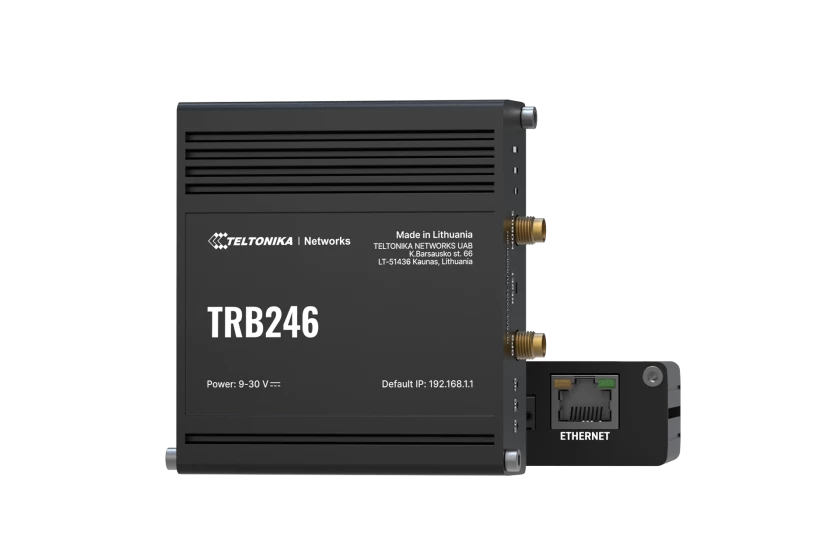

Teltonika TRB246 Industrial IoT Gateway
Designed for industrial IoT deployments in manufacturing, agriculture, and construction, the Teltonika TRB246 Industrial IoT Gateway provides reliable data communication across varying network protocols and conditions. Its aluminium casing is impact-resistant and dust-sealed, supporting operation within a wide temperature range from -40 a0 to 75 a0, ensuring resilience in demanding environments. The gateway offers diverse interface options including RS232, RS485, Ethernet, and configurable digital inputs and outputs, supporting protocols like Modbus, DLMS, and DNP3 for seamless machine-to-machine connectivity.
With dual SIM slots featuring automatic switch-over for maintaining network availability, the TRB246 adapts to fluctuating signal conditions in remote locations. It incorporates advanced network functions such as dynamic routing, VPN protocols (OpenVPN, IPsec, WireGuard), and robust firewall and attack prevention capabilities for continuous operation. Management is streamlined via the Teltonika Remote Management System, enabling remote monitoring and configuration. Compact and easy to mount with options for DIN rail and wall mounting, this industrial-grade gateway supports long-term, low-maintenance deployments in electrically noisy settings.
TRB246 Features
- 4G/LTE (Cat 4), 3G, 2G
- Auto-failover, backup WAN, and more switching scenarios
- Ethernet, I/Os, and serial (RS232, RS485) interfaces with 16-pin terminal block
- Supports DNP3, DLMS, Modbus, and other communication protocols
Request a Quote
Product Type
Manufacturer
Certifications & Standards
CE, EN 301 549, EN 55032, EN 55035, EN 62368-1, FCC, UKCA, WEEE
Ruggedness
Mounting Format
Country Of Manufacture
Lithuania
Mobile module
4G LTE up to 150 DL/50 UL Mbps; 3G up to 42 DL/5.76 UL Mbps; 2G up to 296 DL/236.8 UL Kbps
3GPP Release
Release 11
SIM switch
2 SIM cards, auto-switch cases: weak signal, data limit, SMS limit, on roaming, no network, network denied, data connection fail
Status
IMSI, ICCID, operator, operator state, data connection state, network type, bandwidth, connected band, signal strength (RSSI), SINR, RSRP, RSRQ, EC/IO, RSCP, data sent/received, LAC, TAC, cell ID, ARFCN, UARFCN, EARFCN, MCC, and MNC
SMS
SMS status, SMS configuration, send/read SMS via HTTP POST/GET, EMAIL to SMS, SMS to EMAIL, SMS to HTTP, SMS to SMS, scheduled SMS, SMS autoreply, SMPP
USSD
Supports sending and reading Unstructured Supplementary Service Data messages
Black/White list
Operator black/white list (by country or separate operators)
Multiple PDN
Possibility to use different PDNs for multiple network access and services
Band management
Band lock, Used band status display
SIM idle protection service
When working with devices with two SIM slots, the one not currently in use will remain idle until the device switches to it, meaning that no data is used on the card until then
SIM PIN code management
SIM PIN code management enables setting, changing, or disabling the SIM card's PIN
APN
Auto APN
Bridge
Direct connection (bridge) between mobile ISP and device on LAN
Passthrough
Gateway assigns its mobile WAN IP address to another device on LAN
Ethernet
1 x ETH port, 10/100 Mbps, compliance with IEEE 802.3, IEEE 802.3u, 802.3az standards, supports auto MDI/MDIX crossover
Routing
Static routing, Dynamic routing (BGP, OSPF v2, RIP v1/v2, EIGRP, NHRP), Policy based routing
Network protocols
TCP, UDP, IPv4, IPv6, ICMP, NTP, DNS, HTTP, HTTPS, FTP, SMTP, SSL v3, TLS, ARP, VRRP, PPP, PPPoE, UPNP, SSH, DHCP, Telnet, SMPP, SNMP, MQTT, Wake On Lan (WOL)
VoIP passthrough support
H.323 and SIP-alg protocol NAT helpers, allowing proper routing of VoIP packets
Connection monitoring
Ping Reboot, Wget Reboot, Periodic Reboot, LCP and ICMP for link inspection
Firewall
Port forward, traffic rules, custom rules
Firewall status page
View all your Firewall statistics, rules, and rule counters
Ports management
View device ports, enable and disable each of them, turn auto-configuration on or off, change their transmission speed, and so on
Network topology
Visual representation of your network, showing which devices are connected to which other devices
Hotspot
Captive portal (hotspot), internal/external Radius server, Radius MAC authentication, SMS authorisation, SSO authentication, internal/external landing page, walled garden, user scripts, URL parameters, user groups, individual user or group limitations, user management, 9 default customisable themes and optionality to upload and download customised hotspot themes
DHCP
Static and dynamic IP allocation, DHCP relay, DHCP server configuration, status, static leases: MAC with wildcards
QoS / Smart Queue Management (SQM)
Traffic priority queuing by source/destination, service, protocol or port, WMM, 802.11e
DDNS
Supported >25 service providers, others can be configured manually
DNS over HTTPS
DNS over HTTPS proxy enables secure DNS resolution by routing DNS queries over HTTPS
Network backup
Mobile, VRRP, Wired options, each of which can be used as an automatic Failover
SSHFS
Possibility to mount remote file system via SSH protocol
Authentication
Pre-shared key, digital certificates, X.509 certificates, TACACS+, Internal & External RADIUS users authentication, IP & login attempts block, time-based login blocking, built-in random password generator
Firewall
Pre-configured firewall rules can be enabled via WebUI, unlimited firewall configuration via CLI; DMZ; NAT; NAT-T
Attack prevention
DDOS prevention (SYN flood protection, SSH attack prevention, HTTP/HTTPS attack prevention), port scan prevention (SYN-FIN, SYN-RST, X-mas, NULL flags, FIN scan attacks)
VLAN
Tag-based VLAN separation
Mobile quota control
Mobile data limit, customizable period, start time, warning limit, phone number
WEB filter
Blacklist for blocking out unwanted websites, Whitelist for specifying allowed sites only
Access control
Flexible access control of SSH, Web interface, CLI and Telnet
SSL certificate generation
Let's encrypt support
OpenVPN
Multiple clients and a server can run simultaneously, 27 encryption methods
OpenVPN Encryption
DES-CBC 64, RC2-CBC 128, DES-EDE-CBC 128, DES-EDE3-CBC 192, DESX-CBC 192, BF-CBC 128, RC2-40-CBC 40, CAST5-CBC 128, RC2-64-CBC 64, AES-128-CBC 128, AES-128-CFB 128, AES-128-CFB1 128, AES-128-CFB8 128, AES-128-OFB 128, AES-128-GCM 128, AES-192-CFB 192, AES-192-CFB1 192, AES-192-CFB8 192, AES-192-OFB 192, AES-192-CBC 192, AES-192-GCM 192, AES-256-GCM 256, AES-256-CFB 256, AES-256-CFB1 256, AES-256-CFB8 256, AES-256-OFB 256, AES-256-CBC 256
IPsec
XFRM, IKEv1, IKEv2, with 14 encryption methods for IPsec (3DES, DES, AES128, AES192, AES256, AES128GCM8, AES192GCM8, AES256GCM8, AES128GCM12, AES192GCM12, AES256GCM12, AES128GCM16, AES192GCM16, AES256GCM16)
GRE
GRE tunnel, GRE tunnel over IPsec support
PPTP, L2TP
Client/Server instances can run simultaneously, L2TPv3, L2TP over IPsec support
Stunnel
Proxy designed to add TLS encryption functionality to existing clients and servers without any changes in the program’s code
DMVPN
Method of building scalable IPsec VPNs
SSTP
SSTP client instance support
ZeroTier
ZeroTier VPN client support
WireGuard
WireGuard VPN client and server support
Tinc
Tinc offers encryption, authentication and compression in it's tunnels. Client and server support.
Supported modes
Router
Supported connection types
RS485, TCP
Supported modes
Client, Server
Supported connection types
TCP
Supported modes
Server, Client
Supported connection types
RTU (RS232, RS485), TCP
Custom registers
MODBUS TCP custom register block requests, which read/write to a file inside the router, and can be used to extend MODBUS TCP Client functionality
Supported data formats
8-bit: INT, UINT; 16-bit: INT, UINT (MSB or LSB first); 32-bit: float, INT, UINT (ABCD (big-endian), DCBA (little-endian), CDAB, BADC), HEX, ASCII
Protocol
HTTP(S), MQTT, Azure MQTT, Kinesis
Data to server
Extract parameters from multiple sources and different protocols, and send them all to a single server; Custom LUA scripting, allowing scripts to utilize the router's Data to server feature
Modbus MQTT Gateway
Allows sending commands and receiving data from MODBUS Server through MQTT broker
Supported modes
Station, Outstation
Supported connection types
RS232, RS485, TCP
DLMS Support
DLMS - standard protocol for utility meter data exchange. Support trough serial and TCP
Supported modes
Client
Supported connection types
RS232, RS485, TCP
Teltonika Networks Web API (beta) support
Expand your device's possibilities by using a set of configurable API endpoints to retrieve or change data. For more information, please refer to this documentation: https://developers.teltonika-networks.com
WEB UI
HTTP/HTTPS, status, configuration, FW update, CLI, troubleshoot, multiple event log servers, firmware update availability notifications, event log, system log, kernel log, Internet status
FOTA
Firmware update from server, automatic notification
SSH
SSH (v1, v2)
SMS
SMS status, SMS configuration, send/read SMS via HTTP POST/GET
Call
Reboot, Status, Mobile data on/off, Output on/off, answer/hang-up with a timer
TR-069
OpenACS, EasyCwmp, ACSLite, tGem, LibreACS, GenieACS, FreeACS, LibCWMP, Friendly tech, AVSystem
MQTT
MQTT Broker, MQTT publisher
SNMP
SNMP (v1, v2, v3), SNMP Trap, Brute force protection
JSON-RPC
Management API over HTTP/HTTPS
RMS
Teltonika Remote Management System (RMS)
ThingWorx
Allows monitoring of: WAN Type, WAN IP, Mobile Operator Name, Mobile Signal Strength, Mobile Network Type
Cumulocity - Cloud of Things
Allows monitoring of: Device Model, Revision and Serial Number, WAN Type and IP, Mobile Cell ID, ICCID, IMEI, Connection Type, Operator, Signal Strength. Has reboot and firmware upgrade actions.
Azure IoT Hub
Can be configured with Data to Server to send all the available parameters to the cloud. Has Direct method support which allows to execute RutOS API calls on the IoT Hub. Also has Plug and Play integration with Device Provisioning Service that allows zero-touch device provisioning to IoT Hubs
CPU
Mediatek, 580 MHz, MIPS 24KEc
RAM
128 MB
FLASH storage
16 MB
WEB UI
Update FW from file, check FW on server, configuration profiles, configuration backup
FOTA
Update FW
RMS
Update FW/configuration for multiple devices at once
Keep settings
Update FW without losing current configuration
Factory settings reset
A full factory reset restores all system settings, including the IP address, PIN, and user data to the default manufacturer's configuration
Operating system
RutOS (OpenWrt based Linux OS)
Supported languages
Busybox shell, Lua, C, C++
Development tools
SDK package with build environment provided
GPL customization
You can create your own custom, branded firmware and web page application by changing colours, logos, and other elements in our firmware to fit your or your clients’ needs
Package Manager
The Package Manager is a service used to install additional software on the device
GNSS
GPS, GLONASS, BeiDou, Galileo and QZSS
Coordinates
GNSS coordinates via WebUI, SMS, TAVL, RMS
NMEA
NMEA 0183
NTRIP
NTRIP protocol (Networked Transport of RTCM via Internet Protocol)
Server software
Supported server software TAVL, RMS
Geofencing
Configurable multiple geofence zones
Tracking sensitivity
-157 dBm
Position Accuracy
2.5m CEP
RS232
Terminal block connector: TX, RX, RTS, CTS
RS485
Terminal block connector: D+, D-, R+, R- (2 or 4 wire interface)
Serial functions
Console, Serial over IP, Modem, MODBUS gateway, NTRIP Client
Input
3x Configurable Digital Inputs, 0 - 6 V detected as logic low, 8 - 30 V detected as logic high, 1x Analog input (0 - 30 V)
Output
3x Configurable Digital Outputs, Open collector output, max output 30 V, 300 mA
Events
Email, RMS, SMS
I/O juggler
Allows to set certain I/O conditions to initiate event
Connector
2-pin in 16-pin industrial terminal block
Input voltage range
9 – 30 VDC, reverse polarity protection, surge protection +/-1 kV 50 µs max
Power consumption
Idle: < 1.5 W, Max: < 3.5 W
Ethernet
1 x RJ45 port, 10/100 Mbps
I/O’s
3 x Configurable digital I/O in 16-pin terminal block
Status LEDs
3 x connection status LEDs, 3 x connection strength LEDs, 1 x power LED, 1 x Eth port status LED
SIM
2 x SIM slots (Mini SIM – 2FF), 1.8 V/3 V, double stacked SIM tray
Power
1 x 16-pin terminal block
Antennas
1 x SMA connector for LTE, 1 x SMA connector for GNSS
RS232
4-pin in 16-pin terminal block (TX, RX, RTS, CTS)
RS485
4-pin in 16-pin terminal block (D+, D-, R+, R-)
Reset
Reboot/User default reset/Factory reset button
Casing material
Aluminium housing
Dimensions (W x H x D)
83 x 25 x 74.2 mm
Weight
165 g
Mounting options
DIN rail, wall mount, flat surface (all require additional kit)
Operating temperature
-40 °C to 75 °C
Operating humidity
10% to 90% non-condensing
Ingress Protection Rating
Regulatory
CE, UKCA, EAC, RCM, FCC, IC, CB, WEEE
Standards
EN 55032:2015+A11:2020+A1:2020EN 55035:2017+A11:2020EN 61000-3-3:2013+A1:2019+A2:2021EN IEC 61000-3-2:2019+A1:2021EN 301 489-1 V2.2.3EN 301 489-19 V2.2.1EN 301 489-52 V1.2.1
ESD
EN 61000-4-2:2009
Radiated Immunity
EN IEC 61000-4-3:2020
EFT
EN 61000-4-4:2012
Surge Immunity (AC Mains Power Port)
EN 61000-4-5:2014 +A1:2017
CS
EN 61000-4-6:2014
DIP
EN 61000-4-11:2020
Standards
EN 301 511 V12.5.1EN 301 908-1 V15.2.1EN 301 908-2 V13.1.1EN 301 908-13 V13.2.1EN 303 413 V1.2.1
Standards
CE: EN IEC 62368-1:2020 + A11:2020, EN IEC 62311:2020CB: IEC 62368-1:2018"}]
The Teltonika TRB246 Industrial IoT Gateway is designed and engineered for use in demanding environments where reliability, durability are essential. The TRB246 supports a wide range of industries and operational applications.
Common deployment industries include: Agriculture, Construction, Energy and Utilities, Industrial Manufacturing, Logistics And Supply Chain, Marine And Offshore, Natural Resources and Mining, Oil and Gas.
Across these sectors, the TRB246 is typically used in applications such as Construction Site Supervision And Reporting, Environmental Monitoring And Data Logging, Industrial HMI And Machine Interfacing, Process Control And Shop-Floor Monitoring, SCADA And Control-Room Access, Secure Communications And Command-And-Control, Utilities Inspection And Meter Reading.
These examples demonstrate the versatility of the TRB246 across both industry sectors and real-world operational use cases. Its suitability extends well beyond the scenarios listed above, making it a flexible solution for a broad range of requirements.
For further information, or to assess whether the TRB246 is appropriate for your specific application, please contact us.
The Teltonika TRB246 Industrial IoT Gateway comes with a 24 Month Limited Warrany against defects in workmanship and materials, effective from the date of shipment (unless otherwise agreed in writing).
To receive service under this warranty, the eligible product, Teltonika TRB246 Industrial IoT Gateway, must be presented to RUGGED in the United Kingdom.
For more information about the Teltonika TRB246 Industrial IoT Gateway or to arrange repairs and services not covered by the warranty, please visit the warranty section on our website.
Do you need further details about the Teltonika TRB246 Industrial IoT Gateway, or would you like to discuss a customised solution or demonstration?
At RUGGED, we recognise that every project has its own unique demands. If you have any questions about the Teltonika TRB246 or need a custom 1341 solution designed specifically for you, our team of technical experts are ready to assist you.
Alternative Products
Explore alternative products offering comparable features, performance, and build quality to the model you are currently viewing.
Our related solutions provide variations in configuration, functionality, and form factor to suit different application requirements. Each option has been selected to meet the same high standards of reliability and performance.
Browse the related products below to identify the most suitable fit for your deployment.
- Dual SIM with auto-switching
- Wide temperature range -40 °C to 75 °C
- IP30-rated industrial aluminium housing
- Multiple WAN interfaces RS232 RS485 Ethernet

- Dual SIM auto-switch for network resilience
- Aluminium dust-sealed IP30 casing
- Supports Modbus DLMS and DNP3 protocols
- Advanced VPN and firewall security

- Supports 5G with 4G and 3G fallback
- IP30 rated aluminium housing
- Operates -40 °C to 75 °C temperature range
- MIL-STD-810 certified durability

- Reinforced aluminium housing
- LTE Cat 1 with 3G/2G fallback
- IP30 ingress protection and vibration tolerance
- Extensive VPN and firewall security

Having trouble finding what you're looking for?
Selecting the correct solution for your specific application and operating environment requires careful consideration.
At Rugged, our engineering and product specialists can advise on specifications, environmental suitability, mounting requirements, connectivity, and lifecycle planning to ensure the right fit for your deployment.
With extensive industry experience and a focus on reliability and performance, we help you select a solution aligned with your operational requirements.
Frequently Asked Questions
RUGGED offers free technical support for the lifetime of products you purchase. This includes help with setup, troubleshooting, and integration. Support is available online or directly from the technical team
When considering a gateway vs router, it’s helpful to understand that while a router primarily directs network traffic between different networks, a gateway is a more comprehensive device. A gateway acts as an entry and exit point for all data going in and out of a network, often performing multiple functions. This can include routing, but also firewall protection, network address translation (NAT), and sometimes even modem capabilities, effectively bridging different network protocols. In essence, a router is primarily concerned with forwarding data packets between networks, whereas a gateway encompasses a broader role, facilitating communication between disparate networks or even network types.
For robust network solutions that consider both routing and gateway functionalities, explore the connectivity options available from Rugged Limited.
A network gateway serves as a vital intermediary, enabling communication between networks that use different communication protocols. This means it can translate data between these distinct systems, allowing them to exchange information effectively.
For instance, a gateway might connect a local area network (LAN) to a wide area network (WAN), such as the internet. Without a robust network gateway, devices within one network would be unable to communicate with devices in another, hindering essential data exchange and connectivity. Rugged Limited understands the importance of reliable connectivity solutions for seamless data flow, and the role of efficient gateways in achieving this.
To explore more about network infrastructure and connectivity solutions, visit our connectivity page.
Gateways play a crucial role in modern connectivity by acting as an intermediary to translate and route data between disparate systems. This functionality is vital for many gateway applications, particularly in environments where different communication standards need to coexist.
For example, in industrial settings, gateways can integrate legacy equipment that uses older serial communication protocols with newer IP-based networks, enabling centralised monitoring and control. They are also essential in IoT deployments, allowing diverse sensors and devices to connect to cloud platforms for data aggregation and analysis.
Rugged Limited provides a range of solutions that leverage gateways to facilitate robust and reliable communication. Whether it’s connecting remote assets, managing complex industrial processes, or enabling smart infrastructure, gateways are fundamental to ensuring seamless data flow and operational efficiency. Explore how Rugged Limited can enhance your connectivity solutions with advanced gateway technology.
A network gateway acts as a critical intermediary in communication, translating data between networks that utilise different protocols. This ensures that devices on separate networks can communicate effectively despite their differing architectural rules. For instance, a gateway might translate data from a local area network (LAN) into a format that can be understood by a wide area network (WAN).
Rugged Limited provides a wide array of connectivity solutions, including various types of gateways that facilitate this essential function. These gateways can also perform other vital roles, such as serving as protocol translators, impedance matching devices, and even rate converters, all contributing to the smooth flow of information. This comprehensive functionality is key to understanding how network gateways work in complex network environments, enabling diverse systems to operate as a cohesive unit.
Gateways are indeed a crucial element in modern IoT applications, playing a vital role in connecting various IoT devices to the wider network and cloud platforms. At Rugged, we understand that an IoT Gateway serves as an intermediary, collecting data from sensors and other edge devices before transmitting it for further processing, analysis, or storage.
This functionality is particularly important in environments where numerous devices generate vast amounts of data, as the IoT gateway can perform initial data filtering and aggregation, reducing the bandwidth required for transmission and streamlining the overall data flow. This ensures efficient and reliable operation of IoT systems across diverse applications.
Yes, many gateways offered by Rugged Limited are specifically designed to support cellular connectivity. These devices act as a cellular gateway, enabling seamless communication and data transfer in environments where traditional wired connections may not be feasible or reliable. Our range includes solutions for various cellular standards, ensuring compatibility and high performance across different networks.
Rugged Limited provides gateways that leverage cellular technology to offer dependable internet access and machine-to-machine (M2M) communication. This capability is crucial for applications requiring constant connectivity, remote monitoring, and data logging in challenging industrial or outdoor settings. By incorporating cellular modules, these gateways ensure your systems remain connected and operational, even in distributed or mobile deployments.
Ensuring a secure gateway is paramount for protecting industrial and commercial networks from unauthorised access and cyber threats. Rugged Limited’s gateways are designed with comprehensive security measures to maintain the integrity and confidentiality of your data.
Our secure gateway devices often come equipped with features such as:
- Firewall Protection: To filter network traffic and prevent malicious packets from entering the system.
- VPN Capabilities: For creating secure, encrypted connections over public networks, ensuring data privacy.
- Robust Authentication: To verify the identity of users and devices attempting to access the network.
- Data Encryption: To scramble data, making it unreadable to anyone without the correct decryption key.
By implementing these security protocols, Rugged Limited’s secure gateway solutions help businesses establish a fortified perimeter around their operational technology and IT infrastructure, critical for maintaining reliable and safe operations.
Yes, gateways, particularly those provided by Rugged Limited, can be remotely managed. This functionality allows for efficient monitoring, maintenance, and control from a distance, which is crucial for modern network infrastructures.
Remote management capabilities ensure that your managed gateway operates optimally without requiring physical presence at each device location. This not only streamlines operations but also enhances security and reduces downtime by enabling quick responses to potential issues. Rugged Limited’s solutions are designed to facilitate this level of remote oversight, making it simpler to manage your connectivity.
By leveraging remote management for your gateways, you benefit from improved operational efficiency and robust network performance, ensuring your systems remain connected and secure.
Resilience is a core design theme across Teltonika’s cellular range. Most routers, including the RUT956, RUTX50 and RUTM50, support dual SIM cards with automatic switching triggered by conditions such as weak signal, data limits, roaming, no network or connection failure, with SIM idle protection to avoid unnecessary data use. Beyond cellular, devices offer multiple WAN backup options across Wi-Fi WAN, mobile, VRRP and wired links, each usable for automatic failover, plus load balancing to spread traffic over several connections. VPN support spans IPsec, OpenVPN, WireGuard and more for secure tunnels, and connection monitoring with ping or periodic reboot keeps links healthy. The precise failover and VPN feature set depends on the model and firmware, so verify on the individual product page.
Teltonika devices on rugged.co.uk recur across energy and utilities, industrial manufacturing, logistics and supply chain, rail and transport, marine and offshore, oil and gas, natural resources and mining, defence and emergency services. Typical applications include SCADA and control-room access, fleet management and telematics, process control and shop-floor monitoring, industrial HMI, asset tracking and secure communications. The breadth of the range, from compact TRB gateways through RUT and RUTX routers to 5G RUTM and RUTX50 units, TSW switches and TAP access points, means a single vendor can address routing, gateway, switching and wireless needs across these sectors. As ratings and certifications such as IP30 and MIL-STD-810H are model-specific, match each device to its operating environment and confirm on the product page.
Teltonika Networks is a Lithuanian manufacturer specialising in industrial cellular and Ethernet connectivity, and it holds one of the largest connectivity ranges on rugged.co.uk with more than fifty products. The portfolio is unusually broad: RUT and RUTX cellular routers, RUTM and 5G models, TRB industrial gateways, TRM cellular modems, TSW Ethernet switches and TAP Wi-Fi access points. Most devices run RutOS, an OpenWrt-based Linux operating system, and are managed centrally through the Teltonika Remote Management System (RMS). The line spans entry-level 4G units through to 5G Sub-6 GHz routers, giving buyers a single ecosystem for routing, gateway, switching and wireless needs. Specifications differ widely across families, so confirm bands, ports and ratings on each product page.
Many Teltonika routers are built for demanding industrial use, though ruggedness varies by model. The RUT956, for example, uses a rugged aluminium housing rated IP30 against dust and debris, carries MIL-STD-810H vibration compliance, and operates across a wide -40 C to 75 C range. The 5G RUTX50 shares the aluminium IP30 build, the same wide temperature range and MIL-STD electromagnetic compatibility, with surge-protected 9 to 50 VDC input. Features such as DIN-rail mounting, wide-input DC power and reinforced casings are common across the industrial lines. That said, some models, including certain RUTM units, are rated non-rugged, so do not assume a uniform standard. Always verify the IP rating, temperature range and MIL-STD compliance on the specific product page before specifying.
RutOS is Teltonika’s OpenWrt-based Linux operating system that runs across its router, gateway and modem range, providing routing, firewall, VPN and extensive protocol support along with a package manager for adding software. The Teltonika Remote Management System (RMS) is the cloud platform that sits above it, allowing remote configuration, monitoring, firmware updates and bulk device control across a fleet from one place. Together they let operators deploy and maintain large numbers of devices without site visits, with firmware-over-the-air updates and configuration profiles. RutOS also supports SDK development, custom branded firmware and integrations with platforms such as Azure IoT Hub, Cumulocity and ThingWorx. The exact feature set depends on the device and firmware version, so confirm details on the relevant product page.
Yes. Teltonika’s range includes several 5G Sub-6 GHz devices alongside its extensive 4G LTE line. The RUTX50 industrial router supports 5G SA and NSA with download speeds up to around 3.3 Gbps via 4×4 MIMO, with fallback to 4G LTE Cat 20 and 3G, plus dual-band Wi-Fi and five Gigabit Ethernet ports. The RUTM50 5G router reaches up to 3.4 Gbps using 4×4 MIMO, while the TRM500 brings 5G into a compact USB Type-C modem rated IP30. There is also the TRB500 5G industrial gateway for embedded and IoT use. Most pair 5G with dual SIM auto-failover for resilience. As band support, 3GPP release and throughput differ by model and hardware version, confirm the specification on the individual product page.
Teltonika’s TSW range extends its connectivity ecosystem into wired networking, covering unmanaged and managed Ethernet switches, PoE+ models and DIN-rail units. The TSW200, for instance, provides eight Gigabit PoE+ ports delivering up to 30 W per port within a 240 W budget, plus two SFP fibre ports, all in a full aluminium IP30 housing rated for -40 C to 75 C operation. It supports IEEE 802.3af and 802.3at PoE, jumbo frames up to 9216 bytes and a 20 Gbps non-blocking backplane. Buyers often choose Teltonika switches to keep routing, switching and gateway hardware within one vendor ecosystem and management approach. Port counts, PoE budgets, management capability and temperature ranges vary across the TSW line, so confirm the details on the specific product page.
Teltonika uses model prefixes to signal device class. RUT covers core industrial cellular and Ethernet routers, with RUTX denoting higher-specification routers featuring Gigabit Ethernet, dual-band Wi-Fi and, in the RUTX50, 5G. RUTM is a newer router line that includes 5G models such as the RUTM50. TRB designates compact industrial gateways, often single-purpose units for LTE, GPIO, RS232, RS485, M-Bus, NB-IoT or 5G connectivity. TRM identifies industrial cellular modems, including the 5G TRM500 with USB Type-C. TSW are Ethernet switches and TAP are Wi-Fi access points. This naming makes it easier to scope a build, but capabilities, bands and ruggedness still vary within each family, so confirm the exact specification on the relevant product page before ordering.