


If you are unsure which product is best suited to your requirements, you can contact us directly for expert guidance. Share details such as your use case, environment, compatibility needs, and budget, and we will help you select the most appropriate solution.
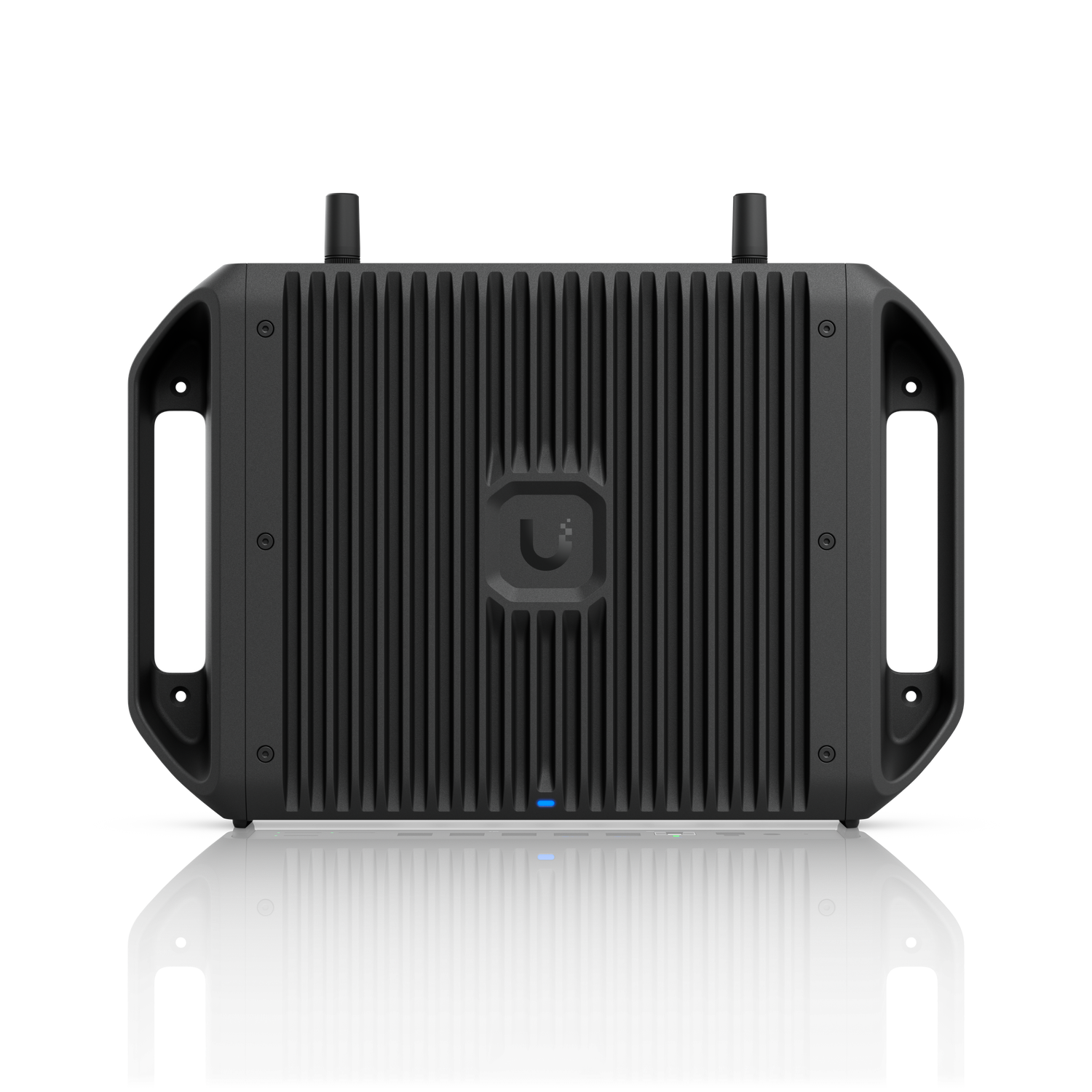

Ubiquiti UniFi Cloud Gateway Industrial
The Ubiquiti UniFi Cloud Gateway Industrial is the hardened top of the UniFi cloud gateway range, built for sites that need a complete network in one box and cannot give it a ventilated cabinet to live in.
Its industrial credentials are specific rather than general. The unit is entirely fanless and rated from minus 30 to 50 degrees celsius, so there is no filter to block and no moving part to wear out in a dusty plant room, an unheated warehouse or a roadside enclosure. Humidity tolerance runs from 5 to 95 per cent non-condensing. Ubiquiti publishes no ingress protection rating for the unit, so it belongs inside a sheltered enclosure rather than mounted in the open, and that is worth settling at design stage.
Performance comes from a quad-core ARM Cortex-A73 running at 2.2 GHz with 3 GB of memory, enough to sustain 5 Gbps of intrusion detection and prevention throughput with the threat engine active. The port set is a 10G SFP+, a 10 GbE RJ45 and four 2.5 GbE RJ45, with up to five configurable as WAN so multiple internet links can be combined for resilience.
Power is the real separator. A 350W system supply delivers a 270W PoE budget with 90W available on individual ports, enough to run pan-tilt-zoom cameras, heated outdoor domes and door access hardware straight from the gateway. Wi-Fi 7 is integrated, and a 128 GB microSD ships fitted for UniFi Protect so a small site can record its own cameras locally.
UCG-Industrial Features
- Completely fanless and rated from minus 30 to 50 degrees celsius, with no filter to block and no moving part to fail
- 270W Power over Ethernet budget with 90W available on individual ports
- 10G SFP+ and 10 GbE RJ45 plus four 2.5 GbE RJ45 ports
- Up to five ports configurable as WAN for multi-link resilience
- Integrated Wi-Fi 7 with Wi-Fi 6 support, 2 x 2 MU-MIMO on both bands
- 5 Gbps intrusion detection and prevention throughput
- 128 GB microSD fitted for UniFi Protect camera recording, expandable to 1 TB
- Router, firewall, UniFi controller, access point, PoE source and recorder in one enclosure
Request a Quote
Product Type
Manufacturer
Ruggedness
Mounting Format
Country Of Manufacture
Taiwan, Vietnam and China
Model
UCG-Industrial
Processor
Quad-core ARM Cortex-A73 at 2.2 GHz
System Memory
3 GB
Storage
128 GB microSD pre-installed, for UniFi Protect
SFP+
1 x 10G SFP+ (10G / 1G)
10 GbE RJ45
1 x PoE+++ (10G / 5G / 2.5G / 1G / 100M)
2.5 GbE RJ45
4 x (2 PoE+++, 2 PoE+) (2.5G / 1G / 100M)
Max WAN Ports
5
MAC Address Table
4,000
Wi-Fi
802.11a/b/g/n/ac/ax/be (Wi-Fi 6, Wi-Fi 7)
Wi-Fi Throughput
5 GHz 4.3 Gbps, 2.4 GHz 688 Mbps
Wi-Fi MIMO
2 x 2 DL/UL MU-MIMO, both bands
Max TX Power
5 GHz 26 dBm, 2.4 GHz 23 dBm
Antenna Gain
5 GHz stub 5 dBi / terminal 6 dBi; 2.4 GHz stub 3 dBi / terminal 6 dBi
Wi-Fi Coverage
115 square metres (1,250 square feet)
IDS / IPS Throughput
5 Gbps
IDS / IPS Signatures
55,000+ with CyberSecure
Managed UniFi Devices
50+
Managed Cameras
15 HD, 8 2K, or 5 4K
Managed Access Hubs
50
Simultaneous Users
500+
Management
Ethernet, Bluetooth
Power Input
DC input 350W PSU, or ATX power (48V). 100 to 240V AC
PoE Budget
270W on DC input; 75W on ATX power
Max PoE per Port
PoE+ 30W; PoE+++ 90W
Power Consumption
28W excluding PoE output
Heat Dissipation
95 BTU/hr excluding PoE output
Cooling
Operating Temperature
-30 to 50 degrees celsius (-22 to 122 degrees fahrenheit)
Operating Humidity
5 to 95 per cent, non-condensing
ESD / EMP Protection
Air plus or minus 8 kV, contact plus or minus 4 kV
Dimensions
307.9 x 203.5 x 43.7 mm
Weight
2.4 kg
Table Stand
203.5 x 100.2 x 21.9 mm, 321 g
Enclosure Material
Polycarbonate, aluminium alloy
Mounting
Wall, desktop on included table stand, or rack via accessory
Ingress Protection
Not published by the manufacturer
Certifications
CE, FCC, IC. NDAA compliant.
Mobile App Minimum
iOS 10.32.0, Android 10.35.0
The Ubiquiti UniFi Cloud Gateway Industrial is designed and engineered for use in demanding environments where reliability, durability and application suitability are essential. The UCG-Industrial supports a wide range of industries and operational applications.
Common deployment industries include: Retail, Security And Surveillance, Warehousing.
Across these sectors, the UCG-Industrial is typically used in applications such as Network Monitoring, Remote Management, Security And Surveillance Operations.
These examples demonstrate the versatility of the UCG-Industrial across both industry sectors and real-world operational use cases. Its suitability extends well beyond the scenarios listed above, making it a flexible solution for a broad range of requirements.
For further information, or to assess whether the UCG-Industrial is appropriate for your specific application, please contact us.
The Ubiquiti UniFi Cloud Gateway Industrial comes with a 2 Year Limited Warranty against defects in workmanship and materials, effective from the date of shipment (unless otherwise agreed in writing).
To receive service under this warranty, the eligible product, Ubiquiti UniFi Cloud Gateway Industrial, must be presented to RUGGED in the United Kingdom.
For more information about the Ubiquiti UniFi Cloud Gateway Industrial or to arrange repairs and services not covered by the warranty, please visit the warranty section on our website.
Request further details about the Ubiquiti UniFi Cloud Gateway Industrial
If you have any questions about the Ubiquiti UCG-Industrial please get in touch today, our team of technical experts are ready to assist you.
Alternative Products
Explore alternative products offering comparable features, performance, and build quality to the model you are currently viewing.
Our related solutions provide variations in configuration, functionality, and form factor to suit different application requirements. Each option has been selected to meet the same high standards of reliability and performance.
Browse the related products below to identify the most suitable fit for your deployment.
UCG-Industrial
- Fanless, minus 30 to 50 degrees celsius
- 270W PoE budget with 90W per port
- 10 GbE and 10G SFP+ connectivity
- Integrated Wi-Fi 7 and local camera recording

Having trouble finding what you're looking for?
Selecting the correct solution for your specific application and operating environment requires careful consideration.
At Rugged, our engineering and product specialists can advise on specifications, environmental suitability, mounting requirements, connectivity, and lifecycle planning to ensure the right fit for your deployment.
With extensive industry experience and a focus on reliability and performance, we help you select a solution aligned with your operational requirements.
Frequently Asked Questions
RUGGED offers free technical support for the lifetime of products you purchase. This includes help with setup, troubleshooting, and integration. Support is available online or directly from the technical team
Many do, and the size of the power budget is one of the more important figures to check. Power over Ethernet allows cameras, wireless access points and door access hardware to be powered down the same cable that carries their data, which removes the need for a local mains supply at each device. Two numbers matter: the total budget the gateway can supply across all ports, and the maximum available on any single port. A device with a large total but a low per port limit will not run a heated outdoor camera or a high power access point. Rugged Limited can match a gateway to the actual load a site needs to support.
Some models include onboard storage and recording software, which allows a site to record its own cameras without a separate network video recorder. Capacity is the limiting factor and is usually quoted as a number of cameras at a given resolution, so the same device might handle a useful number of high definition cameras but only a handful at 4K. Retention period matters just as much as camera count, because longer retention needs more storage regardless of how many cameras are connected. Larger installations will still want dedicated recording hardware. Rugged Limited can work through camera count, resolution and retention to establish whether onboard recording is sufficient.
Cloud gateways are found wherever a site needs a complete, centrally managed network without the space or the staff for a full equipment rack. Retail uses them to run point of sale, guest wireless and camera systems from one device across many branches. Warehousing and logistics use them for site wide wireless coverage and for camera and access control backhaul. Education, hospitality and healthcare use them where a single manageable platform across multiple buildings matters. Industrial sites choose the hardened models for plant rooms and unheated buildings where a conventional appliance would struggle. Rugged Limited focuses on models built for the more demanding of those environments.
Security is one of the main reasons to consolidate onto a cloud gateway rather than assemble equivalent parts. Because the device sits at the boundary of the network, it is the natural place to enforce protection, and most models carry a firewall, virtual private network support, network segmentation so that guest, camera and operational traffic stay separated, and an intrusion detection and prevention engine that inspects traffic for known attack signatures. Two things decide how much of that is useful in practice: the throughput the device can sustain with inspection switched on, and whether the signature set requires an ongoing subscription. Both are worth confirming before purchase. Rugged Limited can confirm those figures for any model in the range.
Remote management is the defining feature of this class of hardware. The gateway can be reached through a manufacturer account from any location, which allows configuration changes, firmware updates, monitoring and fault diagnosis without an engineer attending site. For organisations running several locations, that is usually where the cost saving is found, because routine work that once required travel becomes a task performed from a desk. The same interface generally manages the other equipment connected to the gateway as well, so switches, access points and cameras are administered together. Access should be protected with strong authentication, since a remotely reachable management interface is a target. Rugged Limited can advise on secure deployment.
A cloud gateway is a single device that carries the functions a network would otherwise need several separate boxes to provide. At minimum it combines the router and the firewall with the controller software that manages the other network equipment on site. Higher specification models add a wireless access point, a Power over Ethernet source and a network video recorder in the same enclosure. The cloud in the name refers to how the device is administered rather than to where the work is done. Traffic is routed locally on the hardware itself, while configuration, monitoring and updates can be handled remotely through a manufacturer account. Rugged Limited supplies cloud gateways built for industrial and commercial sites where that consolidation saves both cabinet space and installation time.
A standard router forwards traffic between networks and generally does little else. A cloud gateway starts from that same routing role and adds the functions a site would otherwise buy separately: firewalling, network management for every connected device, and on many models wireless, Power over Ethernet and camera recording. The second difference is administration. A conventional router is usually configured on site or through a separate management server, whereas a cloud gateway is designed to be reached and maintained remotely from a single account. For a distributed estate that difference matters more than the specification sheet, because it decides whether a change requires an engineer visit. Rugged Limited can advise which approach suits a given deployment.
On a typical small to medium site a cloud gateway can take the place of four or five separate pieces of equipment: the router, the firewall appliance, the controller server or hosted controller licence, the wireless access point and, where Power over Ethernet is included, the PoE switch that would otherwise power cameras and access hardware. Models with onboard storage can also remove the need for a separate network video recorder. The practical gains are fewer points of failure, one interface to learn rather than several, and considerably less rack or cabinet space. The trade off is concentration of function, so resilience planning matters. Rugged Limited can help work through what a consolidated design means for a particular site.
One application manages the gateway and everything attached to it: switches, wireless access points, door access hardware and UniFi Protect cameras, all from a single interface. That is the practical argument for specifying UniFi as a system rather than assembling the equivalent parts from several manufacturers. On the industrial gateway the same interface also covers the intrusion detection and prevention engine and the local camera recording, so routing, security and surveillance are administered in one place rather than three.
The gateway provides a 270W Power over Ethernet budget when run from its DC input, with up to 90W available on an individual PoE+++ port and 30W on its PoE+ ports. That is enough headroom to run pan-tilt-zoom cameras, heated outdoor domes, outdoor access points and door access hardware directly from the gateway, so a separate PoE switch can often be taken out of the design. Running the unit from ATX power instead reduces the available budget to 75W.
Yes. It ships with a 128GB microSD card already installed for UniFi Protect, and the card can be increased to 1TB. Ubiquiti rates it for up to fifteen HD cameras, eight 2K cameras or five 4K cameras, so a small to medium site can record locally without buying a separate network video recorder. Larger camera counts or longer retention periods will still need dedicated recording hardware.
There are six ports in total. One is a 10G SFP+ fibre port, one is a 10 GbE RJ45 port that also delivers PoE+++, and four are 2.5 GbE RJ45 ports of which two deliver PoE+++ and two deliver PoE+. Up to five of them can be configured as WAN ports, which allows multiple internet links to be combined for resilience on sites where connectivity cannot be allowed to drop.
It is built for thermally demanding indoor and enclosed locations rather than exposed outdoor use. The gateway is completely fanless and rated from minus 30 to 50 degrees celsius, so there is no filter to block and no moving part to fail in a dusty plant room, an unheated warehouse or a roadside cabinet. Ubiquiti does not publish an ingress protection rating for it, so it should be installed inside a sheltered enclosure rather than mounted in the open.
No. The UniFi controller software runs on the gateway itself, so a site does not need a separate server, cloud key or hosted instance to manage its network. The same unit also acts as the router, firewall, wireless access point, Power over Ethernet source and network video recorder, which is what allows one device to replace what would otherwise be four or five.
Ubiquiti is the manufacturer and UniFi is its product platform. They are not two separate brands. Anything badged UniFi, UCG, USW, U6, U7 or UniFi Protect is made by Ubiquiti, and all of it is managed from the same UniFi application. When specifying a system it is the UniFi name you will see on the hardware and in the software, and Ubiquiti that stands behind it.