


If you are unsure which product is best suited to your requirements, you can contact us directly for expert guidance. Share details such as your use case, environment, compatibility needs, and budget, and we will help you select the most appropriate solution.
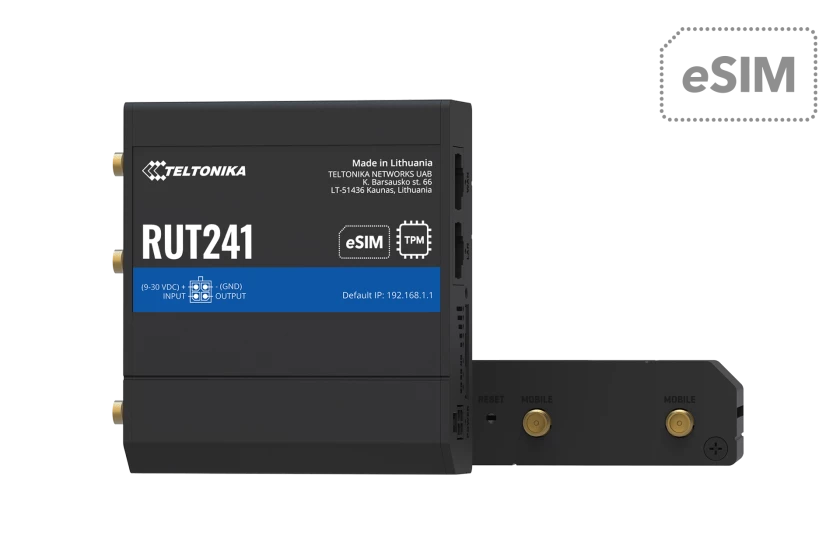

Teltonika RUT241 eSIM™ Industrial 4G eSIM Router
Designed for industrial IoT and M2M deployments, the Teltonika RUT241 eSIM Industrial 4G Router provides secure, multi-network connectivity with seamless failover. It supports a physical SIM slot alongside up to seven eSIM profiles, allowing flexible network management without manual SIM swaps. The robust aluminium housing and impact-resistant casing ensure durability in continuous-duty applications, while its sealed design offers dust protection. This router meets IP30 ingress protection and MIL-STD-810G vibration resistance standards, making it suitable for harsh environments.
Operating temperatures range from -40 C to 75 C, supporting reliable performance across wide conditions. Featuring LTE Cat 4 connectivity with data speeds up to 150 Mbps downlink, it balances speed and resilience. The built-in TPM 2.0 module enhances data security by safeguarding authentication credentials. Additional practical features include dual SMA LTE and RP-SMA Wi-Fi antennas, two RJ45 LAN/WAN ports, digital input/output, and flexible power options including passive PoE. The RUT241 integrates with Teltonika 9s RMS platform for remote management, simplifying device administration in industrial settings.
RUT241-eSIM Features
- 4G LTE (Cat 4), 3G, 2G
- Seamless connectivity with eSIM™ SGP.22
- Next-gen router security with Trusted Platform Module
- For easy & convenient eSIM™ profile management
Request a Quote
Product Type
Manufacturer
Ruggedness
Country Of Manufacture
Lithuania
Mobile module
4G LTE Cat 4 up to 150 DL/50 UL Mbps; 3G up to 21 DL/5.76 UL Mbps; 2G up to 236.8 DL/236.8 UL kbps
3GPP Release
Release 10/11 depending on the hardware version
eSIM
Consumer type eSIM, profile download and removal operations, up to 7 eSIM profiles
Status
IMSI, ICCID, operator, operator state, data connection state, network type, bandwidth, connected band, signal strength (RSSI), SINR, RSRP, RSRQ, EC/IO, RSCP, data sent/received, LAC, TAC, cell ID, ARFCN, UARFCN, EARFCN, MCC, and MNC
SMS
SMS status, SMS configuration, send/read SMS via HTTP POST/GET, EMAIL to SMS, SMS to EMAIL, SMS to HTTP, SMS to SMS, scheduled SMS, SMS autoreply, SMPP
USSD
Supports sending and reading Unstructured Supplementary Service Data messages
Black/White list
Operator black/white list (by country or separate operators)
Multiple PDN
Possibility to use different PDNs for multiple network access and services
Band management
Band lock, Used band status display
SIM PIN code management
SIM PIN code management enables setting, changing, or disabling the SIM card's PIN
APN
Auto APN
Bridge
Direct connection (bridge) between mobile ISP and device on LAN
Passthrough
Router assigns its mobile WAN IP address to another device on LAN
Wireless mode
802.11b/g/n (Wi-Fi 4), Access Point (AP), Station (STA)
Wi-Fi security
WPA2-Enterprise - PEAP, WPA2-PSK, WPA-EAP, WPA-PSK, WPA3-SAE, WPA3-EAP, OWE; AES-CCMP, TKIP, Auto-cipher modes, client separation, EAP-TLS with PKCS#12 certificates, disable auto-reconnect
SSID/ESSID
SSID stealth mode and access control based on MAC address
Wi-Fi users
Up to 50 simultaneous connections
Wireless Connectivity Features
Fast roaming (802.11r), Relayd, BSS transition management (802.11v), radio resource measurement (802.11k)
Wireless MAC filter
Whitelist, blacklist
Wireless QR code generator
Once scanned, a user will automatically enter your network without needing to input login information.
Hotspot
Captive portal (hotspot), internal/external Radius server, Radius MAC authentication, SMS authorisation, SSO authentication, internal/external landing page, walled garden, user scripts, URL parameters, user groups, individual user or group limitations, user management, 9 default customisable themes and optionality to upload and download customised hotspot themes
Routing
Static routing, Dynamic routing (BGP, OSPF v2, RIP v1/v2, EIGRP, NHRP), Policy based routing
Network protocols
TCP, UDP, IPv4, IPv6, ICMP, NTP, DNS, HTTP, HTTPS, SFTP, FTP, SMTP, SSL/TLS, ARP, VRRP, PPP, PPPoE, UPNP, SSH, DHCP, Telnet, SMPP, SNMP, MQTT, Wake On Lan (WOL)
VoIP passthrough support
H.323 and SIP-alg protocol NAT helpers, allowing proper routing of VoIP packets
Connection monitoring
Ping Reboot, Wget Reboot, Periodic Reboot, LCP and ICMP for link inspection
Firewall
Port forward, traffic rules, custom rules
Firewall status page
View all your Firewall statistics, rules, and rule counters
Ports management
View device ports, enable and disable each of them, turn auto-configuration on or off, change their transmission speed, and so on
Network topology
Visual representation of your network, showing which devices are connected to which other devices
Hotspot
Captive portal (hotspot), internal/external Radius server, Radius MAC authentication, SMS authorisation, SSO authentication, internal/external landing page, walled garden, user scripts, URL parameters, user groups, individual user or group limitations, user management, 9 default customisable themes and optionality to upload and download customised hotspot themes
DHCP
Static and dynamic IP allocation, DHCP relay, DHCP server configuration, status, static leases: MAC with wildcards
QoS / Smart Queue Management (SQM)
Traffic priority queuing by source/destination, service, protocol or port, WMM, 802.11e
DDNS
Supported >25 service providers, others can be configured manually
DNS over HTTPS
DNS over HTTPS proxy enables secure DNS resolution by routing DNS queries over HTTPS
Network backup
Wi-Fi WAN, Mobile, VRRP, Wired options, each of which can be used as an automatic Failover
Load balancing
Balance Internet traffic over multiple WAN connections
SSHFS
Possibility to mount remote file system via SSH protocol
WAN
1 x WAN port 10/100 Mbps, compliance IEEE 802.3, IEEE 802.3u, 802.3az standards, supports auto MDI/MDIX
LAN
1 x LAN port, 10/100 Mbps, compliance with IEEE 802.3, IEEE 802.3u standards, supports auto MDI/MDIX
DLMS Support
DLMS - standard protocol for utility meter data exchange
Supported modes
Client
Supported connection types
TCP
Authentication
Firewall
Attack prevention
Pre-shared key, digital certificates, X.509 certificates, TACACS+, Internal & External RADIUS users authentication, IP & login attempts block, time-based login blocking, built-in random password generator
VLAN
Pre-configured firewall rules can be enabled via WebUI, unlimited firewall configuration via CLI; DMZ; NAT; NAT-T
Mobile quota control
DDOS prevention (SYN flood protection, SSH attack prevention, HTTP/HTTPS attack prevention), port scan prevention (SYN-FIN, SYN-RST, X-mas, NULL flags, FIN scan attacks)
WEB filter
Port and tag-based VLAN separation
Access control
Mobile data limit, customizable period, start time, warning limit, phone number
TPM
Blacklist for blocking out unwanted websites, Whitelist for specifying allowed sites only
SSL certificate generation
Flexible access control of SSH, Web interface, CLI and Telnet
OpenVPN
Identification and authentication module, TPM 2.0 standard
OpenVPN Encryption
Let's encrypt support
IPsec
Multiple clients and a server can run simultaneously, 27 encryption methods
GRE
DES-CBC 64, RC2-CBC 128, DES-EDE-CBC 128, DES-EDE3-CBC 192, DESX-CBC 192, BF-CBC 128, RC2-40-CBC 40, CAST5-CBC 128, RC2-64-CBC 64, AES-128-CBC 128, AES-128-CFB 128, AES-128-CFB1 128, AES-128-CFB8 128, AES-128-OFB 128, AES-128-GCM 128, AES-192-CFB 192, AES-192-CFB1 192, AES-192-CFB8 192, AES-192-OFB 192, AES-192-CBC 192, AES-192-GCM 192, AES-256-GCM 256, AES-256-CFB 256, AES-256-CFB1 256, AES-256-CFB8 256, AES-256-OFB 256, AES-256-CBC 256
PPTP, L2TP
XFRM, IKEv1, IKEv2, with 14 encryption methods for IPsec (3DES, DES, AES128, AES192, AES256, AES128GCM8, AES192GCM8, AES256GCM8, AES128GCM12, AES192GCM12, AES256GCM12, AES128GCM16, AES192GCM16, AES256GCM16)
Stunnel
GRE tunnel, GRE tunnel over IPsec support
DMVPN
Client/Server instances can run simultaneously, L2TPv3, L2TP over IPsec support
SSTP
Proxy designed to add TLS encryption functionality to existing clients and servers without any changes in the program’s code
ZeroTier
Method of building scalable IPsec VPNs
WireGuard
SSTP client instance support
Tinc
ZeroTier VPN client support
Supported modes
WireGuard VPN client and server support
Supported connection types
Tinc offers encryption, authentication and compression in it's tunnels. Client and server support.
Supported modes
Client, Server
Supported connection types
TCP
Custom registers
Server, Client
Supported data formats
TCP
Protocol
MODBUS TCP custom register block requests, which read/write to a file inside the router, and can be used to extend MODBUS TCP Client functionality
Data to server
8-bit: INT, UINT; 16-bit: INT, UINT (MSB or LSB first); 32-bit: float, INT, UINT (ABCD (big-endian), DCBA (little-endian), CDAB, BADC), HEX, ASCII
Modbus MQTT Gateway
HTTP(S), MQTT, Azure MQTT, Kinesis
Supported modes
Extract parameters from multiple sources and different protocols, and send them all to a single server; Custom LUA scripting, allowing scripts to utilize the router's Data to server feature
Supported connection
Allows sending commands and receiving data from MODBUS Server through MQTT broker
Teltonika Networks Web API (beta) support
Station, Outstation
WEB UI
TCP
FOTA
Expand your device's possibilities by using a set of configurable API endpoints to retrieve or change data. For more information, please refer to this documentation: https://developers.teltonika-networks.com
SSH
HTTP/HTTPS, status, configuration, FW update, CLI, troubleshoot, multiple event log servers, firmware update availability notifications, event log, system log, kernel log, Internet status
SMS
Firmware update from server, automatic notification
Call
SSH (v1, v2)
TR-069
SMS status, SMS configuration, send/read SMS via HTTP POST/GET
MQTT
Reboot, Status, Mobile data on/off, Output on/off, answer/hang-up with a timer, Wi-Fi on/off
SNMP
OpenACS, EasyCwmp, ACSLite, tGem, LibreACS, GenieACS, FreeACS, LibCWMP, Friendly tech, AVSystem
JSON-RPC
MQTT Broker, MQTT publisher
RMS
SNMP (v1, v2, v3), SNMP Trap, Brute force protection
ThingWorx
Management API over HTTP/HTTPS
Cumulocity - Cloud of Things
Teltonika Remote Management System (RMS)
Azure IoT Hub
Allows monitoring of: WAN Type, WAN IP, Mobile Operator Name, Mobile Signal Strength, Mobile Network Type
CPU
Allows monitoring of: Device Model, Revision and Serial Number, WAN Type and IP, Mobile Cell ID, ICCID, IMEI, Connection Type, Operator, Signal Strength. Has reboot and firmware upgrade actions.
RAM
Can be configured with Data to Server to send all the available parameters to the cloud. Has Direct method support which allows to execute RutOS API calls on the IoT Hub. Also has Plug and Play integration with Device Provisioning Service that allows zero-touch device provisioning to IoT Hubs
FLASH storage
Mediatek, 580 MHz, MIPS 24KEc
WEB UI
128 MB, DDR2
FOTA
16 MB, SPI Flash
RMS
Update FW from file, check FW on server, configuration profiles, configuration backup
Keep settings
Update FW
Factory settings reset
Update FW/configuration for multiple devices at once
Operating system
Update FW without losing current configuration
Supported languages
A full factory reset restores all system settings, including the IP address, PIN, and user data to the default manufacturer's configuration
Development tools
RutOS (OpenWrt based Linux OS)
GPL customization
Busybox shell, Lua, C, C++
Package Manager
SDK package with build environment provided
Input
You can create your own custom, branded firmware and web page application by changing colours, logos, and other elements in our firmware to fit your or your clients’ needs
Output
The Package Manager is a service used to install additional software on the device
Events
1 x Digital Input, 0 - 6 V detected as logic low, 8 - 30 V detected as logic high
I/O juggler
1 x Digital Output, Open collector output, max output 30 V, 300 mA
Connector
Email, RMS, SMS
Input voltage range
Allows to set certain I/O conditions to initiate event
PoE (passive)
4-pin industrial DC power socket
Power consumption
9 – 30 VDC, reverse polarity protection; surge protection >31 VDC 10us max
Ethernet
Passive PoE over spare pairs. Possibility to power up through LAN1 port, not compatible with IEEE802.3af, 802.3at and 802.3bt standards, Mode B, 9 - 30 VDC
I/O’s
< 6.5 W Max
Status LEDs
2 x RJ45 ports, 10/100 Mbps
SIM
1 x Digital Input, 1 x Digital Output on 4-pin power connector
Power
3 x Connection type status LEDs, 5 x Connection strength LEDs, 2 x LAN status LEDs, 1 x Power LED
Antennas
1 x SIM slot (Mini SIM – 2FF), 1.8 V/3 V, external SIM holder
Reset
1 x 4-pin power connector
Casing material
2 x SMA for LTE, 1 x RP-SMA for Wi-Fi antenna connectors
Dimensions (W x H x D)
Reboot/User default reset/Factory reset button
Weight
Aluminium housing, plastic panels
Mounting options
83 x 25 x 74 mm
Operating temperature
125 g
Operating humidity
DIN rail, wall mount, flat surface (all require additional kit)
Ingress Protection Rating
-40 °C to 75 °C
Regulatory
10% to 90% non-condensing
Operator
Standards
ESD
AT&T, Verizon, T-Mobile, Uscellular
Radiated Immunity
EN 55032:2015 + A11:2020 EN 55035:2017 + A11:2020 EN IEC 61000-3-2:2019 EN 61000-3-3:2013 + A1:2019 EN 301 489-1 V2.2.3 EN 301 489-17 V3.2.4 Final Draft EN 301 489-52 V1.2.0
EFT
EN 61000-4-2:2009
Surge Immunity (AC Mains Power Port)
EN IEC 61000-4-3:2020
CS
EN 61000-4-4:2012
DIP
EN 61000-4-5:2014 + A1:2017
Standards
EN 61000-4-6:2014
Standards
EN 61000-4-11:2020
The Teltonika RUT241 eSIM™ Industrial 4G eSIM Router is designed and engineered for use in demanding environments where reliability, durability are essential. The RUT241-eSIM supports a wide range of industries and operational applications.
Common deployment industries include: Construction, Energy and Utilities, Industrial Manufacturing, Logistics And Supply Chain, Natural Resources and Mining, Oil and Gas, Public Sector, Security And Surveillance.
Across these sectors, the RUT241-eSIM is typically used in applications such as Field Data Capture And Reporting, Health, Safety, And Compliance Inspections, Mobile Workforce Operations, Preventive And Corrective Maintenance, Process Control And Shop-Floor Monitoring, SCADA And Control-Room Access, Secure Communications And Command-And-Control, Vehicle-Mounted Computing (MDTs / VMCs).
These examples demonstrate the versatility of the RUT241-eSIM across both industry sectors and real-world operational use cases. Its suitability extends well beyond the scenarios listed above, making it a flexible solution for a broad range of requirements.
For further information, or to assess whether the RUT241-eSIM is appropriate for your specific application, please contact us.
The Teltonika RUT241 eSIM™ Industrial 4G eSIM Router comes with a 24 Month Limited Warrany against defects in workmanship and materials, effective from the date of shipment (unless otherwise agreed in writing).
To receive service under this warranty, the eligible product, Teltonika RUT241 eSIM™ Industrial 4G eSIM Router, must be presented to RUGGED in the United Kingdom.
For more information about the Teltonika RUT241 eSIM™ Industrial 4G eSIM Router or to arrange repairs and services not covered by the warranty, please visit the warranty section on our website.
Do you need further details about the Teltonika RUT241 eSIM™ Industrial 4G eSIM Router, or would you like to discuss a customised solution or demonstration?
At RUGGED, we recognise that every project has its own unique demands. If you have any questions about the Teltonika RUT241-eSIM or need a custom Cellular Router solution designed specifically for you, our team of technical experts are ready to assist you.
Alternative Products
Explore alternative products offering comparable features, performance, and build quality to the model you are currently viewing.
Our related solutions provide variations in configuration, functionality, and form factor to suit different application requirements. Each option has been selected to meet the same high standards of reliability and performance.
Browse the related products below to identify the most suitable fit for your deployment.
RUT260
- Dual SIM with WAN failover
- Durable aluminium housing with IP30 protection
- LTE Cat 6 up to 300 Mbps download
- Surge and vibration protection

RUT241
- 4G LTE with automatic WAN failover
- Reinforced aluminium housing with -40 °C to 75 °C operating range
- Dual Ethernet ports plus Wi-Fi 4 support
- Reverse polarity and surge protection for continuous operation

RUTM09
- Dual SIM auto-switching for network continuous availability
- Up to 300 Mbps data throughput with 4G LTE Cat 6
- Anodised aluminium housing with IP30 protection
- Integrated GNSS for precise location tracking

RUT956
- Dual SIM auto-switching for network reliability
- IP30 aluminium housing for dust protection
- MIL-STD vibration tolerance for durability
- Wide -40 to 75 °C operating temperature range

Having trouble finding what you're looking for?
Selecting the correct solution for your specific application and operating environment requires careful consideration.
At Rugged, our engineering and product specialists can advise on specifications, environmental suitability, mounting requirements, connectivity, and lifecycle planning to ensure the right fit for your deployment.
With extensive industry experience and a focus on reliability and performance, we help you select a solution aligned with your operational requirements.
Frequently Asked Questions
RUGGED offers free technical support for the lifetime of products you purchase. This includes help with setup, troubleshooting, and integration. Support is available online or directly from the technical team
VPN routers significantly enhance network security by creating an encrypted tunnel for all data traffic leaving your network. This means that every device connected to the VPN router, including those that cannot typically run VPN software themselves, benefits from the security and anonymity of a Virtual Private Network.
Rugged routers often include advanced security features such as firewalls, intrusion prevention, and content filtering, which further protect against cyber threats. The encryption provided by a VPN router safeguards your online activities from eavesdropping, data interception, and other malicious attacks, making it a secure choice for protecting your digital footprint. Our range of secure rugged routers provides robust connectivity with integrated security.
Remote management is a key feature for many VPN router models offered by Rugged Limited, enabling convenient oversight and control from any location. This capability allows administrators to manage network settings, monitor performance, and troubleshoot issues without needing to be physically present at the router’s location.
For instance, some of Rugged Limited’s VPN router solutions support centralized management platforms, which streamline the deployment and maintenance of multiple devices across various sites. This is especially beneficial for large-scale operations or distributed networks. Our range of rugged routers, often equipped with VPN functionalities, are built to support such advanced management features, ensuring reliable and secure remote access for ongoing operations.
A VPN Router offers significant advantages for Internet of Things (IoT) deployments, particularly when it comes to security and centralized management. By routing all IoT device traffic through an encrypted tunnel, a VPN router protects against unauthorised access and cyber threats, which is crucial given the often-limited security features of individual IoT devices.
Furthermore, a VPN Router simplifies network management for IoT ecosystems. Instead of configuring each device individually, all devices connected to the router automatically benefit from the VPN’s security protocols. This ensures consistent protection and allows for secure remote access to IoT devices, which is vital for monitoring and control in various applications.
A VPN router enhances your internet connection by encrypting all traffic flowing through it, offering a secure and flexible network. However, it’s important to understand that a VPN router primarily adds a layer of security and privacy on top of an existing internet connection. It doesn’t inherently provide the internet connection itself in the way fixed broadband does.
For situations where fixed broadband is unavailable or unreliable, solutions such as 4G and 5G routers can act as primary internet sources, providing robust cellular connectivity. When combined with the capabilities of a VPN, such as those offered by a Rugged VPN-enabled router, you gain both internet access and enhanced security for all connected devices. This setup is particularly beneficial for remote sites, mobile deployments, or as a failover for traditional broadband.
Therefore, while a VPN router is crucial for securing your network, its ability to replace fixed broadband depends on whether it’s integrated with a cellular modem or used in conjunction with a separate internet access method.
A VPN router establishes a Virtual Private Network (VPN) connection directly from the router itself, rather than from individual devices. This means that all devices connected to the router, whether via Wi-Fi or Ethernet, automatically benefit from the VPN’s security and privacy features without needing individual VPN client software installed.
This centralisation of the VPN connection simplifies network security, ensuring that all data traffic originating from your network is encrypted and routed through the VPN server. It offers a robust solution for maintaining privacy and securing data transmissions for multiple devices simultaneously, making it an ideal choice for both businesses and individuals seeking comprehensive network protection. Rugged Limited offers a range of rugged routers, engineered for reliable performance in demanding environments, which can be configured to operate as VPN routers, providing secure and stable connectivity.
A VPN router serves to provide a secure and encrypted connection for all devices connected to the network it manages. Instead of installing VPN software on each individual device, a VPN router establishes a single, protected connection for every device, including those that might not support VPN clients natively, such as smart TVs, gaming consoles, or IoT devices. This ensures that all internet traffic leaving your network is encrypted, safeguarding your online activities from potential threats and enhancing your digital privacy.
Rugged Limited offers a range of rugged routers, some of which are designed to support VPN functionalities, providing robust and reliable solutions for secure network deployments in various demanding environments.
In industrial environments, the need for secure and reliable communication is paramount. VPN routers provide a crucial layer of security, safeguarding data transmission across various industrial applications. These devices are designed to operate in challenging conditions, making them ideal for deployments in factories, remote monitoring stations, and other harsh industrial settings.
A key advantage of using a VPN router in an industrial context is its ability to create secure tunnels for data. This is essential for protecting intellectual property, operational data, and confidential communications from cyber threats. Rugged Limited understands these unique requirements and offers robust solutions tailored for such demanding applications.
The integration of a VPN router ensures that industrial control systems, SCADA networks, and remote access points are protected, allowing for secure remote management and data exchange without compromising the integrity or availability of critical infrastructure.
Yes, many of our VPN routers at Rugged Limited are engineered to support cellular connectivity, providing robust and flexible internet access, especially in remote or challenging environments where traditional wired connections may be unreliable or unavailable. This feature allows a VPN router to utilise 4G or 5G networks to establish an internet connection, which can then be secured with VPN technology.
Our solutions cater to diverse operational needs, ensuring that secure network access is maintained regardless of location. For example, our industrial-grade VPN routers are often equipped with multiple SIM card slots and support for various cellular bands, ensuring high availability and seamless failover capabilities. This makes them ideal for applications requiring continuous, secure connectivity, such as mobile command centres, remote monitoring, or temporary site deployments. Explore our range of rugged routers designed for demanding applications.
Teltonika devices on rugged.co.uk recur across energy and utilities, industrial manufacturing, logistics and supply chain, rail and transport, marine and offshore, oil and gas, natural resources and mining, defence and emergency services. Typical applications include SCADA and control-room access, fleet management and telematics, process control and shop-floor monitoring, industrial HMI, asset tracking and secure communications. The breadth of the range, from compact TRB gateways through RUT and RUTX routers to 5G RUTM and RUTX50 units, TSW switches and TAP access points, means a single vendor can address routing, gateway, switching and wireless needs across these sectors. As ratings and certifications such as IP30 and MIL-STD-810H are model-specific, match each device to its operating environment and confirm on the product page.
Teltonika Networks is a Lithuanian manufacturer specialising in industrial cellular and Ethernet connectivity, and it holds one of the largest connectivity ranges on rugged.co.uk with more than fifty products. The portfolio is unusually broad: RUT and RUTX cellular routers, RUTM and 5G models, TRB industrial gateways, TRM cellular modems, TSW Ethernet switches and TAP Wi-Fi access points. Most devices run RutOS, an OpenWrt-based Linux operating system, and are managed centrally through the Teltonika Remote Management System (RMS). The line spans entry-level 4G units through to 5G Sub-6 GHz routers, giving buyers a single ecosystem for routing, gateway, switching and wireless needs. Specifications differ widely across families, so confirm bands, ports and ratings on each product page.
Many Teltonika routers are built for demanding industrial use, though ruggedness varies by model. The RUT956, for example, uses a rugged aluminium housing rated IP30 against dust and debris, carries MIL-STD-810H vibration compliance, and operates across a wide -40 C to 75 C range. The 5G RUTX50 shares the aluminium IP30 build, the same wide temperature range and MIL-STD electromagnetic compatibility, with surge-protected 9 to 50 VDC input. Features such as DIN-rail mounting, wide-input DC power and reinforced casings are common across the industrial lines. That said, some models, including certain RUTM units, are rated non-rugged, so do not assume a uniform standard. Always verify the IP rating, temperature range and MIL-STD compliance on the specific product page before specifying.
RutOS is Teltonika’s OpenWrt-based Linux operating system that runs across its router, gateway and modem range, providing routing, firewall, VPN and extensive protocol support along with a package manager for adding software. The Teltonika Remote Management System (RMS) is the cloud platform that sits above it, allowing remote configuration, monitoring, firmware updates and bulk device control across a fleet from one place. Together they let operators deploy and maintain large numbers of devices without site visits, with firmware-over-the-air updates and configuration profiles. RutOS also supports SDK development, custom branded firmware and integrations with platforms such as Azure IoT Hub, Cumulocity and ThingWorx. The exact feature set depends on the device and firmware version, so confirm details on the relevant product page.
Yes. Teltonika’s range includes several 5G Sub-6 GHz devices alongside its extensive 4G LTE line. The RUTX50 industrial router supports 5G SA and NSA with download speeds up to around 3.3 Gbps via 4×4 MIMO, with fallback to 4G LTE Cat 20 and 3G, plus dual-band Wi-Fi and five Gigabit Ethernet ports. The RUTM50 5G router reaches up to 3.4 Gbps using 4×4 MIMO, while the TRM500 brings 5G into a compact USB Type-C modem rated IP30. There is also the TRB500 5G industrial gateway for embedded and IoT use. Most pair 5G with dual SIM auto-failover for resilience. As band support, 3GPP release and throughput differ by model and hardware version, confirm the specification on the individual product page.
Teltonika’s TSW range extends its connectivity ecosystem into wired networking, covering unmanaged and managed Ethernet switches, PoE+ models and DIN-rail units. The TSW200, for instance, provides eight Gigabit PoE+ ports delivering up to 30 W per port within a 240 W budget, plus two SFP fibre ports, all in a full aluminium IP30 housing rated for -40 C to 75 C operation. It supports IEEE 802.3af and 802.3at PoE, jumbo frames up to 9216 bytes and a 20 Gbps non-blocking backplane. Buyers often choose Teltonika switches to keep routing, switching and gateway hardware within one vendor ecosystem and management approach. Port counts, PoE budgets, management capability and temperature ranges vary across the TSW line, so confirm the details on the specific product page.
Teltonika uses model prefixes to signal device class. RUT covers core industrial cellular and Ethernet routers, with RUTX denoting higher-specification routers featuring Gigabit Ethernet, dual-band Wi-Fi and, in the RUTX50, 5G. RUTM is a newer router line that includes 5G models such as the RUTM50. TRB designates compact industrial gateways, often single-purpose units for LTE, GPIO, RS232, RS485, M-Bus, NB-IoT or 5G connectivity. TRM identifies industrial cellular modems, including the 5G TRM500 with USB Type-C. TSW are Ethernet switches and TAP are Wi-Fi access points. This naming makes it easier to scope a build, but capabilities, bands and ruggedness still vary within each family, so confirm the exact specification on the relevant product page before ordering.
Resilience is a core design theme across Teltonika’s cellular range. Most routers, including the RUT956, RUTX50 and RUTM50, support dual SIM cards with automatic switching triggered by conditions such as weak signal, data limits, roaming, no network or connection failure, with SIM idle protection to avoid unnecessary data use. Beyond cellular, devices offer multiple WAN backup options across Wi-Fi WAN, mobile, VRRP and wired links, each usable for automatic failover, plus load balancing to spread traffic over several connections. VPN support spans IPsec, OpenVPN, WireGuard and more for secure tunnels, and connection monitoring with ping or periodic reboot keeps links healthy. The precise failover and VPN feature set depends on the model and firmware, so verify on the individual product page.